Mastering Simultaneous Shifting and String-Crossing on the Cello

String crossing and shifting are two fundamental techniques that present stumbling points on their own. Put them together and they can become an unfortunate blemish in an otherwise good performance. Without the necessary co-ordination between the left and right sides which are performing different physical tasks and a thorough understanding of the positions visited, this particular technique will lack good tone and accuracy of rhythm and intonation. Amazingly, it is all too often skimmed over by teachers who assume that if their students are reasonably capable of each individual technique they will easily be able to combine them. Just because I can easily pat my head and rub my belly doesn’t necessarily mean I can perform both actions simultaneously!

The first step towards mastering any technique is to understand why it exists and what it will enable you to do. The simultaneous string-cross and shift presents itself in two particular situations. The first of these and typically the first time we encounter the technique in our study of the cello is when we play in more remote keys which eliminate the use of some or all of the open strings. The second is when we need to avoid open strings in order to play sustained passages with consistent tone and vibrato or to avoid awkward string crossing in faster passages. One of the great advantages of being able to manage this technique well is the significant increase in potential fingering patterns that become available, which means that we have a much better and more varied sound palette at our disposal.

Most of us first encounter the need to shift and cross in scales: most notably, E Major. However students who play with orchestras frequently come across techniques they have not yet covered in their lessons and this is often one of them. To me it has always made sense to introduce the technique earlier on – while the neck positions are being studied – using home key scales such as F and D majors (two octaves) thus giving the student and early introduction to alternate fingering patterns and making remote keys far less daunting to play and sight-read. All it takes to comfortably manage a piece, study or exercise in a key with four or more sharps or flats is a sensible fingering pattern and the instinct to determine where extended positions are required – a simple matter of knowing where you are in the given scale.

I believe the reason it is easier to learn scales such as D or F majors with fingering patterns that avoid open strings is simply that they are already familiar territory. Furthermore, there are open string targets available to test intonation along the way. Any student who has been introduced to the first four positions on the cello should be comfortable with major keys containing up to three sharps and two flats, and minor keys with two flats and one sharp. They will also have covered extended positions; and string-crossing* is one of the first techniques we are introduced to on the cello. By combining these techniques we can introduce the valuable technique of simultaneous shifting and string crossing to avoid open strings.

Below are two versions of the scale of F major (two octaves); the first with conventional fingering and the second with a fingering pattern that avoids open strings and happens to be identical to the conventional fingering of E major (two octaves), thus making F major an ideal means of preparing for E major.


In the second fingering pattern, each string cross coincides with a position change. Most students find this confusing at first because with the exception of the shift from first to fourth position on the D string, backward shifts lead to a higher pitch in the ascending scale and visa-versa in the descending scale. So to grow accustomed to this counter-intuitive event, the following exercise can be practised until the left hand knows precisely how to move from one group of notes to the next.

Once you’ve mastered this exercise, you should be able to play the new F major fingering pattern fluently with no obvious gaps at the string crosses. Don’t rush: if you can’t play it slowly, there’s no reason why you’d be able to play it three or four times faster! Learning new shifts and fingering patterns, along with hearing the pitch you’re aiming for before playing it takes time and careful, well-planned practice.

The next step is to apply the F major exercise to the scale of E major as follows.
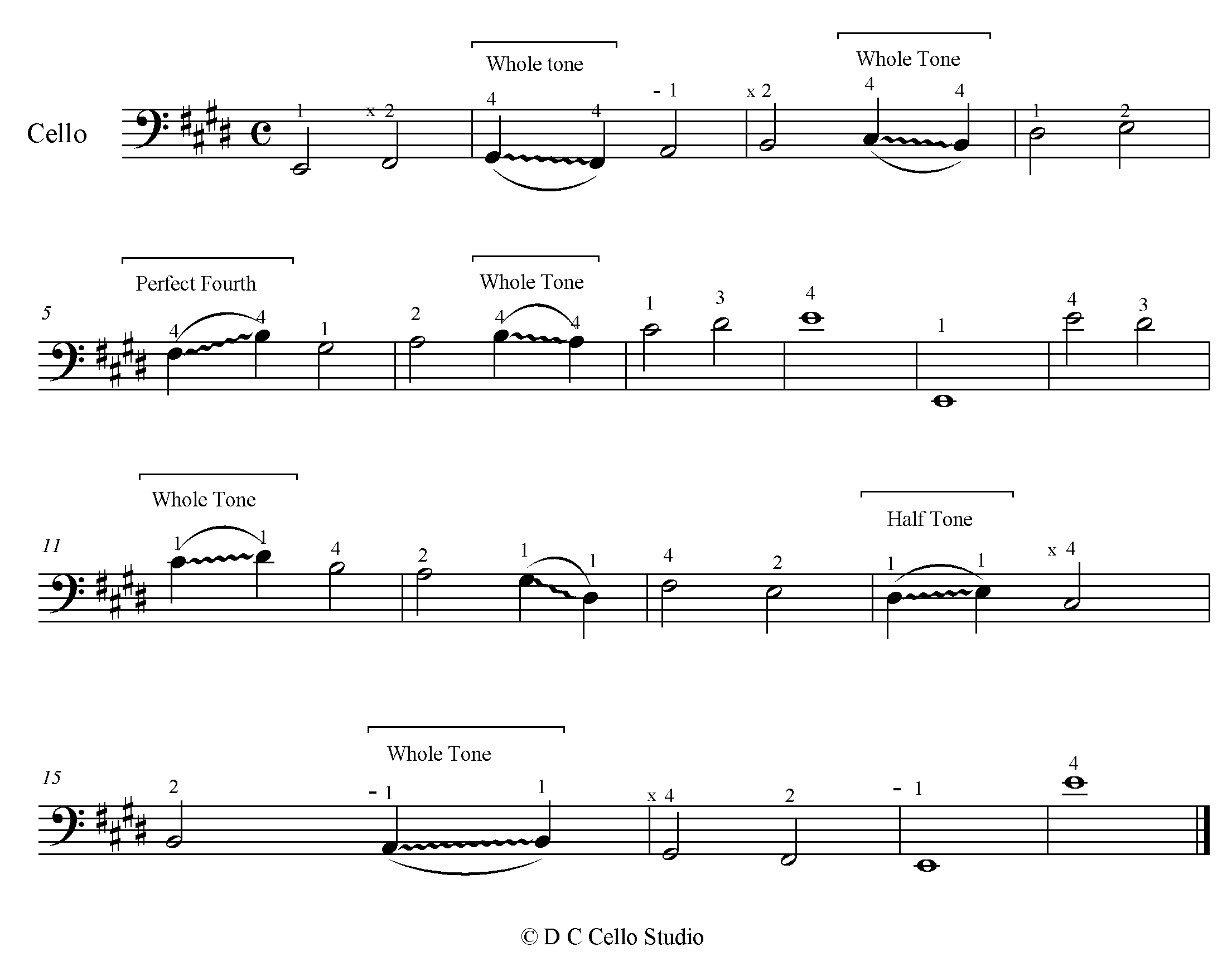
*The fact that it remains one of the most important and subtly difficult techniques to master is another article entirely!

© D C Cello Studio

Order or download my latest electronica-cello feast, Cellotronics

A Beginner’s Guide to Keys in Music

Firstly, let’s define three important terms which are easy to get confused and therefore important to be distinguished from each other before exploring how they are related.

1) Key: a family of notes which belong together and have a distinctive sound or “colour”. A key can be major or minor and is represented by a key signature (see definition 2). Every key has 7 individual notes which are represented in the scale (see definition 3) of the key.
2) Key signature: a representation of the accidentals found in a key. These are shown at the start of each stave just after the clef and just before the time signature* and greatly reduce the number of accidentals that have to be shown in the main body of the score**. The order of accidentals in a key signature does not always follow the order in which they appear in the scale. Instead, they follow the order in which they appear from one scale to the next.
3) Scale: a representation of the notes belonging to a key in ascending and descending order starting and ending on the root note of the key. There are 3 main types of scales: major (which represent major keys), harmonic minor and melodic minor (which represent minor keys). Each type follows a specific order of intervals***

* Times signatures, unlike clefs and key signatures, are only shown at the start of the first stave and do not appear again unless there is a change of time signature in the music

** Score: a written or notated representation of music

*** Interval: the pitch distance between 2 consecutive notes (e.g. C – D = a whole tone or major second; C – D-flat = a half tone or minor second)

Understanding major and minor keys and their relationships

The reason there are related major and minor keys is because they share the same key signature. Major keys are easier to understand because they do not deviate from their key signature, and have only 1 scale to represent them. Major scales are based on the following sequence of intervals:

Whole tone; whole tone; half tone; whole tone; whole tone; whole tone; half tone.

So let’s see how that relates to the actual notes of C major:

C – D: whole tone

D – E: whole tone

E – F: half tone

F – G: whole tone

G – A: whole tone

A – B: whole tone

B – C: half tone

Now let’s look at F major:

F – G: whole tone

G – A: whole tone

A – B-flat: half tone

B-flat – C: whole tone

C – D: whole tone

D – E: whole tone

E – F: half tone

So no matter what the key, major scales follow an identical sequence of intervals. This is why they all have different key signatures. In order to follow the same sequence, they have to follow a unique pattern of notes.

Minor keys are more complex than major scales. Every minor key has 2 different types of minor scale as previously mentioned: a harmonic minor scale and a melodic minor scale. Each type of scale deviates from the key signature in a slightly different way.

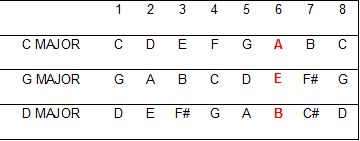
But let’s forget that confusing fact for a moment and look at how major scales and minor scales relate to each other.  Every key signature relates to both a major key and a minor key. The table below shows 3 ascending major scales. The numbers above the scales relate to the steps of the scales.  The red note in bold print in each scale is the root note of the relative minor.

You’ll notice that it is always the 6th step of the major scale that is the root note of the relative minor key. This is the easiest way to find out which minor key shares the key signature of a major key.

In contemporary rock and pop music, we often come across “natural minor” scales (also known as the aeolian mode). These are minor scales that do not deviate from the key signature and take on the following sequence of intervals:

Whole tone; half tone; whole tone; whole tone; half tone; whole tone; whole tone.

This is a (natural) minor, which is related to C major (as you can see in the table above)

A – B: whole tone

B – C: half tone

C – D: whole tone

D – E: whole tone

E – F: half tone

F – G: whole tone

G – A: whole tone

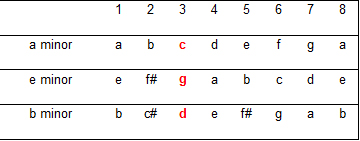
The next table shows the three natural minor scales related to the major scales above. This time, you’ll notice that the bold print red note, which is the root note of the relative major key, has changed to the third step.

In classical music, minor scales are altered in 2 different ways. This gives minor keys a more distinct and defined sound, and distinguishes them from major keys. The first alteration is the harmonic minor scale, in which the 7th step is always raised up by a half tone as shown in a harmonic minor below:

A – B: whole tone

B – C: half tone

C – D: whole tone

D – E: whole tone

E – F: half tone

F – G#: augmented second

G# – A: half tone

The augmented second is the largest interval you’ll find in any classical scale, and is only found in the harmonic minor. Play and listen to the scale several times to hear its distinct sound.  The table below shows 3 examples of harmonic minor scales. The altered 7th steps are in bold italic.

Now for the melodic minor scale, which I like to call the chameleon scale because it changes its colours on the way down.  Melodic minor scales raise the 6th and 7th steps by a half tone in the ascending half and lower them back down by a half step in the descending half. This means that the scale has a different sequence of intervals in its ascending and descending halves as shown in a melodic minor:

Ascending

A – B: whole tone

B – C: half tone

C – D: whole tone

D – E: whole tone

E – F#: whole tone

F# – G#: whole tone

G# – A: half tone

Descending

A – G: whole tone

G – F: whole tone

F – E: half tone

E – D: whole tone

D – C: whole tone

C – B: half tone

B – A: whole tone

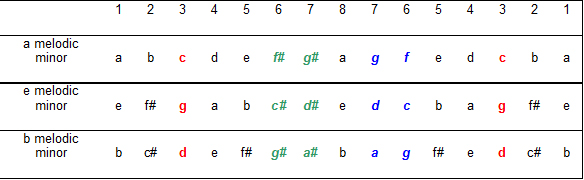
Note also that the descending melodic minor scale is a natural minor which follows the key signature.  Play and listen to the scale, and be sure to hear the difference between the melodic minor and the harmonic minor. The table below shows 3 examples of melodic minor scales. The relative majors are once again marked in bold red; the altered notes in the ascending scale are shown in bold italic green, and the lowered notes in the descending scale are shown in bold italic blue:

The altered notes in harmonic and melodic minor scales are always shown as accidentals within the score, and not in the key signature.

So how do we know whether a piece of music is in a minor key or a major key? First look at the key signature and make sure that you know which major and minor key it belongs to. Then look at about the first 8 bars of the music. If you see any accidentals within the score (not, the key signature – you’ve already looked at that) check what they are. If they happen to be the 6th and/ or 7th step of the minor key, then you can be certain that the music is in a minor key and not a major key.  If you see no accidentals within the score, or accidentals that are not the 6th or 7th steps of the minor key, you can be certain of it being a major key.

© D C Cello Studio

Order or download my latest electronica-cello feast, Cellotronics

© D C Cello Studio

Essay on the Craft of ‘Cello-Playing by Christopher Bunting: A Short Review

An essential read for any serious cellist or cello teacher. Christopher Bunting (1924 – 2005) was a world-renowned cellist and pedagogue whose methods and compositions have become an integral part of the cello-verse. He singled himself out as a teacher with his deeply intellectual and holistic approach to the learning process, stressing the importance of the psychological influence over the physical act of playing in each individual.

Essay on the Craft of ‘Cello-Playing goes into great detail on the psychology of playing, offering a great deal of food for thought and encouraging each cellist to closely examine his or her emotional and intellectual workings in order to assess why they encounter certain (well-known) physical hurdles on the instrument, and work out how to overcome them. Bunting clearly didn’t believe in short-cuts, and his playing was certainly a testament to this fact. Described by the Daily Telegraph as “a Master” and Die Welt as having “highly developed musical comprehension, prodigious technique and outstanding artistry”, we are left in no doubt as to what incredibly good hands we’re in from the first word to the last.

Christopher Bunting was by many accounts an intense and inspiring teachr with a fertile musical imagination and a dry sense of humour, all of which is evident and comes across rather beautifully in his writing. Expect silly puns at unexpected moments along with fabulous analogies and comparisons that put difficult concepts into sharp perspective.

Essay on the Craft of ‘Cello-Playing is more than a treatise on playing the cello, and also contains imaginative and hugely helpful exercises (many of which feature in the much more condensed Portfolio of Cello Exercises) with detailed explanations on what each is for, and how best to approach it.

Not an easy read, being fairly dense and packed with a remarkable amount of information and thought, but I can’t recommend it enough. Persevere if you find it heavy-going at first!

© D C Cello Studio

Holding the Bow

There’s that undesirable word again: hold. In this case it can’t be supplemented with anything else, because in order to get the bow from a resting position to the cello we have no choice but to hold it. Furthermore, we continue to hold it (if as gently as possible) once it is on the string. What we need to avoid right from the start is that urge to grip the bow, pushing the thumb against the frog and squeezing against the thumb with the fingers. Most people who pick up the bow for the first time without any instruction from a teacher or experienced player will approach it as an everyday task, closing the hand firmly around the frog without considering the impact this physical action has on the mobility of the wrist and even the elbow joint. This is not a problem when picking up a coffee mug, opening a door or opening a jar. All of these actions are over in seconds and often require a short burst of strength. But if we maintain that level of tension in the hand and forearm for a longer duration we soon start to feel it. Furthermore, the fluid movements required of the entire arm for producing good, well-controlled sound on the cello will simply not happen if there is excess, unyielding tension in any of the muscles.

It is not my intention to provide an overly prescriptive description of where to place each finger on the bow. There are many different schools of thought on this subject, and many readers will already have been given very detailed and specific instruction on it. All cellists settle on something that works best for them depending on the size and shape of their hands along with what they’ve been taught. Not only can it be desperately confusing when you’ve learnt one thing and someone comes along suggesting you do something quite different, I believe it shifts the focus from the important points of using the correct muscles, keeping the joints mobile and learning about fluid, balanced motion to battling with reshaping your hand and fingers, potentially building up the very tension you need to avoid.

I do, however have a few basic but useful tips regarding your hand. Firstly, you need to look for a natural shape which allows for free, independent movement of your fingers and thumb. Let your hand hang loosely in front of you, palm and fingers facing downwards. Your thumb should be roughly behind your index finger. If you gently bend its first joint, the right corner of the thumb tip will be opposite the middle finger, which is where it will be most comfortable and flexible when holding the bow. Secondly, you need to be aware of and maintain sensitivity in each finger. As bow technique develops and the cellist works on what will become his signature sound, the sensitivity of his fingers plays a major role in making subtle changes and articulations.

To become used to the idea of letting the bow hang out of the fingers rather than gripping it, it is very useful to practice with something of roughly equal width and weight, but much shorter length such as a marker pen, small bottle or container. Find the same natural relaxed hand shape (ensuring that the entire arm is engaged but relaxed and the shoulder is not pulling up) and place the object lightly between the fingers. There will be sufficient resistance between the fingers and object to prevent it from falling, but not so much that the fingers cannot feel its weight. Maintaining a relaxed shoulder and supporting the arm from the muscles around the shoulder blade (the infraspinatus muscles – see image a below) and in the chest (the pectoralis muscles or pecs – see image b below), practice drawing a straight line in front of you using the second joints of your fingers. You should start with your arm at your side and your hand slightly to the left of your shoulder; and finish with your elbow joint more-or-less straightened. At no point should your shoulder come up. Getting used to this movement, thinking in straight lines and using the arm as a fluid unit will make life a lot less daunting when you first take the bow in hand and draw it across the string. It will also help you to overcome your very natural first instinct to grasp the bow rather than letting it rest on the string.

An additional factor adding to the desire to grip the bow tightly is the understandable notion that one can’t get sound out of the cello without pressing the bow onto the string, which would require a strong grip. Many novice cellists use this approach with or without guidance to the contrary from their teachers. It serves them well enough – sometimes for several years. But they will always get to that painful turning point where they realise their bow technique can no longer progress, and they have to re-learn how to use the bow. I was one of those cellists, and it was not until I got to Music College, seven years after my first cello lessons, that I took that painful, time-consuming and hugely frustrating U-turn in my technical approach. I don’t recommend it!

So how is it possible to get anything other than a whispery, insubstantial sound without pressing the bow into the string? The answer is simple, but takes time to put into practice: arm weight and leverage. When we start a down-bow the weight of the arm is on top of the string, making it easy to apply as much or little as we want. As we draw the bow across the string, that weight moves further and further away, making it necessary for the arm to act as a lever in order to maintain the same amount of friction between the bow hair and string. The entire movement is driven by the infraspinatus and pectoralis muscles, which support the entire arm and make it possible to maintain a loose hold on the bow from frog to tip. This is another reason why I emphasised the importance of free movement in the hips in my seat and support articles. Being able to move the torso from the hips makes it possible for the body to stay balanced on the point of contact, or point of friction between bow and string. A skilled cellist practically dances around this point with well-co-ordinated, fluid movements.

Finally, it really helps to think of the bow as an extension of your arm. You may well have heard this before: many teachers find it a useful way to get their students to blend instrument, bow and body. Observe how much amazing movement is possible in each of your joints. Think of the join between your hand and the frog as another of those beautiful, flexible joints that enable us to use our bodies in diverse ways.

a)

Infraspinatus Muscle

b)

Pectoralis Major Muscle

© D C Cello Studio

Order or download my latest electronica-cello feast, Cellotronics