A Beginner’s Guide to Keys in Music

Firstly, let’s define three important terms which are easy to get confused and therefore important to be distinguished from each other before exploring how they are related.

1) Key: a family of notes which belong together and have a distinctive sound or “colour”. A key can be major or minor and is represented by a key signature (see definition 2). Every key has 7 individual notes which are represented in the scale (see definition 3) of the key.
2) Key signature: a representation of the accidentals found in a key. These are shown at the start of each stave just after the clef and just before the time signature* and greatly reduce the number of accidentals that have to be shown in the main body of the score**. The order of accidentals in a key signature does not always follow the order in which they appear in the scale. Instead, they follow the order in which they appear from one scale to the next.
3) Scale: a representation of the notes belonging to a key in ascending and descending order starting and ending on the root note of the key. There are 3 main types of scales: major (which represent major keys), harmonic minor and melodic minor (which represent minor keys). Each type follows a specific order of intervals***

* Times signatures, unlike clefs and key signatures, are only shown at the start of the first stave and do not appear again unless there is a change of time signature in the music

** Score: a written or notated representation of music

*** Interval: the pitch distance between 2 consecutive notes (e.g. C – D = a whole tone or major second; C – D-flat = a half tone or minor second)

Understanding major and minor keys and their relationships

The reason there are related major and minor keys is because they share the same key signature. Major keys are easier to understand because they do not deviate from their key signature, and have only 1 scale to represent them. Major scales are based on the following sequence of intervals:

Whole tone; whole tone; half tone; whole tone; whole tone; whole tone; half tone.

So let’s see how that relates to the actual notes of C major:

C – D: whole tone

D – E: whole tone

E – F: half tone

F – G: whole tone

G – A: whole tone

A – B: whole tone

B – C: half tone

Now let’s look at F major:

F – G: whole tone

G – A: whole tone

A – B-flat: half tone

B-flat – C: whole tone

C – D: whole tone

D – E: whole tone

E – F: half tone

So no matter what the key, major scales follow an identical sequence of intervals. This is why they all have different key signatures. In order to follow the same sequence, they have to follow a unique pattern of notes.

Minor keys are more complex than major scales. Every minor key has 2 different types of minor scale as previously mentioned: a harmonic minor scale and a melodic minor scale. Each type of scale deviates from the key signature in a slightly different way.

But let’s forget that confusing fact for a moment and look at how major scales and minor scales relate to each other.  Every key signature relates to both a major key and a minor key. The table below shows 3 ascending major scales. The numbers above the scales relate to the steps of the scales.  The red note in bold print in each scale is the root note of the relative minor.
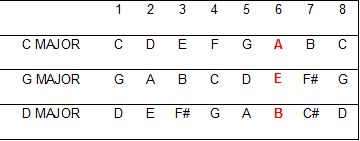
You’ll notice that it is always the 6th step of the major scale that is the root note of the relative minor key. This is the easiest way to find out which minor key shares the key signature of a major key.

In contemporary rock and pop music, we often come across “natural minor” scales (also known as the aeolian mode). These are minor scales that do not deviate from the key signature and take on the following sequence of intervals:

Whole tone; half tone; whole tone; whole tone; half tone; whole tone; whole tone.

This is a (natural) minor, which is related to C major (as you can see in the table above)

A – B: whole tone

B – C: half tone

C – D: whole tone

D – E: whole tone

E – F: half tone

F – G: whole tone

G – A: whole tone

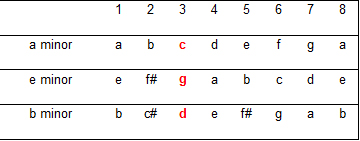
The next table shows the three natural minor scales related to the major scales above. This time, you’ll notice that the bold print red note, which is the root note of the relative major key, has changed to the third step.
In classical music, minor scales are altered in 2 different ways. This gives minor keys a more distinct and defined sound, and distinguishes them from major keys. The first alteration is the harmonic minor scale, in which the 7th step is always raised up by a half tone as shown in a harmonic minor below:

A – B: whole tone

B – C: half tone

C – D: whole tone

D – E: whole tone

E – F: half tone

F – G#: augmented second

G# – A: half tone

The augmented second is the largest interval you’ll find in any classical scale, and is only found in the harmonic minor. Play and listen to the scale several times to hear its distinct sound.  The table below shows 3 examples of harmonic minor scales. The altered 7th steps are in bold italic.

Now for the melodic minor scale, which I like to call the chameleon scale because it changes its colours on the way down.  Melodic minor scales raise the 6th and 7th steps by a half tone in the ascending half and lower them back down by a half step in the descending half. This means that the scale has a different sequence of intervals in its ascending and descending halves as shown in a melodic minor:

Ascending

A – B: whole tone

B – C: half tone

C – D: whole tone

D – E: whole tone

E – F#: whole tone

F# – G#: whole tone

G# – A: half tone

Descending

A – G: whole tone

G – F: whole tone

F – E: half tone

E – D: whole tone

D – C: whole tone

C – B: half tone

B – A: whole tone

Note also that the descending melodic minor scale is a natural minor which follows the key signature.  Play and listen to the scale, and be sure to hear the difference between the melodic minor and the harmonic minor. The table below shows 3 examples of melodic minor scales. The relative majors are once again marked in bold red; the altered notes in the ascending scale are shown in bold italic green, and the lowered notes in the descending scale are shown in bold italic blue:
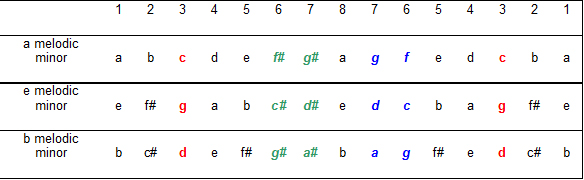
The altered notes in harmonic and melodic minor scales are always shown as accidentals within the score, and not in the key signature.

So how do we know whether a piece of music is in a minor key or a major key? First look at the key signature and make sure that you know which major and minor key it belongs to. Then look at about the first 8 bars of the music. If you see any accidentals within the score (not, the key signature – you’ve already looked at that) check what they are. If they happen to be the 6th and/ or 7th step of the minor key, then you can be certain that the music is in a minor key and not a major key.  If you see no accidentals within the score, or accidentals that are not the 6th or 7th steps of the minor key, you can be certain of it being a major key.

© D C Cello Studio

Order or download my latest electronica-cello feast, Cellotronics

© D C Cello Studio

Holding the Bow

There’s that undesirable word again: hold. In this case it can’t be supplemented with anything else, because in order to get the bow from a resting position to the cello we have no choice but to hold it. Furthermore, we continue to hold it (if as gently as possible) once it is on the string. What we need to avoid right from the start is that urge to grip the bow, pushing the thumb against the frog and squeezing against the thumb with the fingers. Most people who pick up the bow for the first time without any instruction from a teacher or experienced player will approach it as an everyday task, closing the hand firmly around the frog without considering the impact this physical action has on the mobility of the wrist and even the elbow joint. This is not a problem when picking up a coffee mug, opening a door or opening a jar. All of these actions are over in seconds and often require a short burst of strength. But if we maintain that level of tension in the hand and forearm for a longer duration we soon start to feel it. Furthermore, the fluid movements required of the entire arm for producing good, well-controlled sound on the cello will simply not happen if there is excess, unyielding tension in any of the muscles.

It is not my intention to provide an overly prescriptive description of where to place each finger on the bow. There are many different schools of thought on this subject, and many readers will already have been given very detailed and specific instruction on it. All cellists settle on something that works best for them depending on the size and shape of their hands along with what they’ve been taught. Not only can it be desperately confusing when you’ve learnt one thing and someone comes along suggesting you do something quite different, I believe it shifts the focus from the important points of using the correct muscles, keeping the joints mobile and learning about fluid, balanced motion to battling with reshaping your hand and fingers, potentially building up the very tension you need to avoid.

I do, however have a few basic but useful tips regarding your hand. Firstly, you need to look for a natural shape which allows for free, independent movement of your fingers and thumb. Let your hand hang loosely in front of you, palm and fingers facing downwards. Your thumb should be roughly behind your index finger. If you gently bend its first joint, the right corner of the thumb tip will be opposite the middle finger, which is where it will be most comfortable and flexible when holding the bow. Secondly, you need to be aware of and maintain sensitivity in each finger. As bow technique develops and the cellist works on what will become his signature sound, the sensitivity of his fingers plays a major role in making subtle changes and articulations.

To become used to the idea of letting the bow hang out of the fingers rather than gripping it, it is very useful to practice with something of roughly equal width and weight, but much shorter length such as a marker pen, small bottle or container. Find the same natural relaxed hand shape (ensuring that the entire arm is engaged but relaxed and the shoulder is not pulling up) and place the object lightly between the fingers. There will be sufficient resistance between the fingers and object to prevent it from falling, but not so much that the fingers cannot feel its weight. Maintaining a relaxed shoulder and supporting the arm from the muscles around the shoulder blade (the infraspinatus muscles – see image a below) and in the chest (the pectoralis muscles or pecs – see image b below), practice drawing a straight line in front of you using the second joints of your fingers. You should start with your arm at your side and your hand slightly to the left of your shoulder; and finish with your elbow joint more-or-less straightened. At no point should your shoulder come up. Getting used to this movement, thinking in straight lines and using the arm as a fluid unit will make life a lot less daunting when you first take the bow in hand and draw it across the string. It will also help you to overcome your very natural first instinct to grasp the bow rather than letting it rest on the string.

An additional factor adding to the desire to grip the bow tightly is the understandable notion that one can’t get sound out of the cello without pressing the bow onto the string, which would require a strong grip. Many novice cellists use this approach with or without guidance to the contrary from their teachers. It serves them well enough – sometimes for several years. But they will always get to that painful turning point where they realise their bow technique can no longer progress, and they have to re-learn how to use the bow. I was one of those cellists, and it was not until I got to Music College, seven years after my first cello lessons, that I took that painful, time-consuming and hugely frustrating U-turn in my technical approach. I don’t recommend it!

So how is it possible to get anything other than a whispery, insubstantial sound without pressing the bow into the string? The answer is simple, but takes time to put into practice: arm weight and leverage. When we start a down-bow the weight of the arm is on top of the string, making it easy to apply as much or little as we want. As we draw the bow across the string, that weight moves further and further away, making it necessary for the arm to act as a lever in order to maintain the same amount of friction between the bow hair and string. The entire movement is driven by the infraspinatus and pectoralis muscles, which support the entire arm and make it possible to maintain a loose hold on the bow from frog to tip. This is another reason why I emphasised the importance of free movement in the hips in my seat and support articles. Being able to move the torso from the hips makes it possible for the body to stay balanced on the point of contact, or point of friction between bow and string. A skilled cellist practically dances around this point with well-co-ordinated, fluid movements.

Finally, it really helps to think of the bow as an extension of your arm. You may well have heard this before: many teachers find it a useful way to get their students to blend instrument, bow and body. Observe how much amazing movement is possible in each of your joints. Think of the join between your hand and the frog as another of those beautiful, flexible joints that enable us to use our bodies in diverse ways.

a)

Infraspinatus Muscle

b)

Pectoralis Major Muscle

© D C Cello Studio

Order or download my latest electronica-cello feast, Cellotronics

Supporting Your Cello

I specifically chose the word “supporting” rather than “holding” in the title of this section, and you may be wondering why. The simple reason is that holding things often implies grasping or clutching, neither of which promote pain free, well balanced technique. Most people playing the cello for the first few times notice an overwhelming tendency to hold it by squeezing their knees against it and using one or both of their hands to steady it. By creating an accurate mental image and understanding of how to interact with your cello from the earliest possible stage, you have a much better chance of laying a solid foundation for great cello technique.

Now that you’ve explored your ideal sitting posture and the concept of balancing on your seat, you’re ready to bring your cello into the equation. Your first task is to pull out and fasten the spike, and you’ll want to know precisely how long it ought to be. The answer is annoying, but get used to it because you’ll be hearing it a lot in response to pertinent questions about playing the cello: It depends. You see, it’s not only your height that will influence the length of your spike; it’s the length of your legs, your torso, your arms and your seat. Then there is the terribly inexact science of personal preference, which will take a while to discover. As a rough guide: when you are sitting with your cello, the C tuning peg (the lower right-hand peg) should be level with or just behind your left ear. If you feel as if the cello is pushing you backwards and it seems to hobble around just above your knees rather than rest between them, the spike is too long. Conversely if the angle of the instrument is too vertical, the spike is too short. You will find yourself experimenting with different lengths for a while in the early stages. When you have found a length that works for you, use a permanent marker to make a small mark on the spike. This will avoid wasting time lengthening and shortening it before you can settle into your practice sessions.

As I have already pointed out, your cello should rest against you, supported by your posture as opposed to gripped and held in place. By placing your feet roughly in line with your hips and turning your toes out, you will find that your knees can fall further apart without creating any tension in your thighs. This also creates more surface area for the lower half of the cello to rest against and ensures that the instrument won’t move about as soon as any weight is applied to it from the bow or left hand. It helps to think of creating a nest with your legs for the cello to lie in – well supported but not squeezed or gripped. The left hand side of the cello should be slightly higher so that the A string is turned inwards towards the bow or plucking hand. The lower ends of the C-bouts (the c-shaped curves forming the cello’s narrow “waist”) should be just above or at the top of your knees. Placing your left foot slightly in front of your left foot will help to achieve the subtle angle necessary for comfortable bow technique. The upper end of the cello body should rest very lightly against your sternum; the bulk of the instrument’s weight being supported by your knees. An excellent and very simple way to test whether your cello’s weight is correctly distributed is to lean slightly backwards away from the instrument. If it follows you and stays against your chest, you haven’t quite created that nest it needs between your knees. If the cello stays where it is and feels secure, you’ve got it! Now check the mobility in your hips: you should be able to turn your upper body around by a few degrees to either side from the hips. Make sure you’re not just twisting your shoulders and upper back – it needs to be your entire torso.

To help you make your cello part of your body space as you sit with it as opposed to an external and rather awkward object, put both arms around it and give it a hug – even if it makes you feel a little silly. You need to bond with the instrument physically, mentally and emotionally. The latter two happen with time and practice, but won’t happen without the former.

© D C Cello Studio

Are You Sitting Comfortably?

You may well be tempted to skip past this section and get straight down to the business of holding and playing your cello. After all, everyone knows how to sit don’t they? It’s one of the very first things we learn to do with our bodies, which means that we’ve had plenty of practice! But we’ve had just as much time to apply all the bad physical habits we pick up along the way, such as slouching, arching the back and forgetting our centre of gravity. Even those whose activities include the likes of martial arts or ballet – both of which focus heavily on posture and balance – can easily forget all of those valuable lessons when sitting in class or at a computer. So it is certainly worth following guidelines and actively observing our seated posture before picking up the cello.

First, we should discuss the height of your chair. A chair that is either too high or too low can cause a great deal of tension throughout the body which will only increase when you attempt to hold and play your cello. The ideal height enables an angle slightly larger than 90 degrees between the abdomen and thigh. The seat of your chair should be flat and firm. Some cellists prefer a seat with a slight forward incline (with the front of the seat lower than the back). This type of seat is also endorsed by many physiotherapists and practitioners of Alexander Technique and Feldenkrais Method because it encourages the upper body to lean forward towards the cello. However it takes getting used to and is not a recommendation I would make for beginners. To be avoided at all costs is the bucket seat, commonly found in schools and public halls and enemy number one of the human posture. Likewise any seat with a backward incline or excessively soft cushion should not be used. For anyone 5 foot or taller, an adjustable piano or keyboard bench is ideal. For those shorter than this, a child’s chair with a flat seat will do, so long as the angle between the abdomen and thigh is correct.

Balance is crucial. Many of my students look baffled when I tell them this – how difficult can it be to balance on a chair? Well, not at all difficult, but unfortunately it’s just as easy to sit with poor balance and unless we can tell the difference, we’re more inclined towards the latter. To begin with, it is best to sit towards the front of the seat, and to sit on the bones of your buttocks. Feet should always be flat on the floor, and should always be in a position that allows you to stand up without having to move them. Considering that you’ll need space between your knees for the cello to rest comfortably, you’ll need to place your feet a small distance apart from each other. Turning them outwards will allow your knees to fall further apart from each other than your feet, which in turn creates plenty of surface area from above the knees down to the calves for the cello to rest against. A good cello posture always implies motion, as if you were about to get up from your chair and walk in fluid motions. To enhance this it helps to incline your upper body slightly forward from your hips. Feel your weight going straight into your seat through the bones in your buttocks and don’t try to hold your upper body in any particular position. Swing your arms backwards and forwards to ensure that they move freely and easily. Now test the mobility in your hips by turning your entire upper body to the left then to the right. If you’re feeling the urge to do the Time Warp, leave the room and take a cold shower.

Finally, your neck should be tension-free and your head should be on top of your body, not in front of it. Remember this when you have your cello in hand and feel tempted to peer at your bow or left hand. It is easy to forget just how heavy the head is. When it’s hanging in front of the body it will create unwanted tension in the neck and back. A well aligned body, with the head balanced at the top of the spinal cord, allowance for the natural curvature of the spine and no “blockage” in any of the joints will feel light and will perform inordinately better than a misaligned body.
© D C Cello Studio