Did you find this post useful? Please consider making a donation.
© D C Cello Studio 2012
I was browsing a forum for classical music students the other day. My eye was caught by a thread entitled something like this: “What is the shortest time you can take to get to grade 8?” At first I was annoyed at the silliness of such a question. I was about to write an admonishing response, telling him how ridiculous he was to be so obsessed with racing toward a relatively meaningless qualification when he should be focusing on how to become the best he could at expressing himself on his instrument. But then I thought about myself at that age – around fifteen.
In my mid-teens I was fiercely ambitious and deeply dissatisfied at not yet having passed my grade 8 cello exam with distinction. I had only been playing the cello for around five years, but had already managed to perform Bruch’s Kol Nidrei (rather messily) at the local Youth Concerto Festival, and was regularly taking repertoire far beyond my ability to my lessons and nagging my teacher to let me play it: the Saint-Saëns Concerto No. 1; the Lalo Concerto; both Haydn Concertos and more. I wore him down and he let me take on the Saint-Saëns. I can honestly say I put a brand new spin on it, and not in a good way! I used eye-wateringly bad fingering patterns throughout – especially in the double-stop passage. My tempi were all over the place and bore no resemblance whatsoever to the score directions; dictated instead by my technical inadequacies, which were numerous and getting worse rather than better with my hours of hacking away at music beyond my reach rather than working on my weaknesses.
I eventually abandoned the Saint-Saëns Concerto: by the time I got to the third movement even I had to admit defeat. I never touched that concerto again except in a few sessions in my practice room many years later, when I would set down a pile of my favourite pieces next to my chair and systematically read through bits and pieces of them. But I certainly didn’t stop taking on repertoire that required much better chops than I had in those days. I wasn’t alone either. There were several cellists in my age group at the music school I attended, and the competition between us was stiff to say the least. We all played in the regional and national youth orchestras together, and the annual seating auditions were a tense, unpleasant affair. This was typical behaviour for young people of our age, and perhaps it was a valuable introduction to the fiercely competitive and political nature of the world we were planning to enter. Part of the problem was that our teachers were no better, and in hindsight seemed a little too focused on who had the most advanced students; whose students had played the most challenging repertoire and whose students had the most achievements behind them. Amongst those achievements of course, should be the coveted certificate proclaiming Grade 8 Passed with Distinction. This meant that we were never discouraged from our competitive behaviour – far from it in fact.
I played my Grade 8 exam at seventeen and by some unfathomable miracle, managed to scrape a distinction for it. I played the Allemande from Bach’s Third Suite in C; the second movement from the Lalo Cello Concerto and an arranged piece by Hindemith called Meditation. Each of those pieces was a struggle to perform with the accurate performance of certain sections always a matter of hoping for the best but expecting the worst. I remember coming out of the exam room in a state, having barely managed to avoid crying during the exam itself. I was convinced that I would achieve a low pass at best, and during the agonising wait for my results began to have rather sensible thoughts about slowing down and paying more attention to my desperately unreliable technique. Then the certificate arrived in the post and lo and behold: it was a distinction! All thoughts about sensible and necessary technical practice went straight out of the window and once again as my ego expanded beyond its previous inflated size I began to think of myself as a performer of great and terrifying repertoire.
When I arrived at music college around six months later I felt ready to conquer the classical music world. I was going to enter and win all of the major music competitions, play in all of the concerto festivals and make my way abroad on some fabulous music scholarship. I hadn’t bargained for the fact that my teacher – one of the most sought after in the country – had attracted a frightening number of cellists from all over the country, many of whom had been given a far more disciplined grounding than I. I was now a very insignificant fish in a much bigger sea. Furthermore, she did not suffer fools gladly and was certainly not going to indulge over-inflated egos in need of a reality check.
I recall my first lesson with her as if it was yesterday. I needed to prepare a piece to play for her, and I decided to play it safe with something I had learned three years previously and played many times since: Vocalise by Rachmaninov. I gave my customary emotionally over-the-top performance with much face-pulling and moving about. Instead of the flattery I had come to expect at the end of it, she gave me the brutally honest and detailed feedback I was to become accustomed to from her. Although I failed to see it at the time, it was in fact very encouraging, and essentially told me that I had raw talent and musicality in abundance, but that my technique was really in need of an overhaul. I was a little put out – if she thought my technique seemed insufficient on a piece like the Vocalise, what would she have said about my rendition of the Lalo Concerto? I was going to become more than a little put out as a battle of wills ensued. Of course many of you already know this part of the story as I touched on it in my previous post about efficient practising. At the risk of boring you with tails of my youthful foolishness, I shall continue this story as it relates directly to the point I wish to make in this post.
It went like this: I – still flush with the success of my distinction and a few other orchestral and performance achievements that year – was in no mood to be told that I needed to go back to basics in order to develop better and more reliable habits. My teacher, by no means confronted with the first upstart of her career, put her foot down firmly and used my attempts at proving her wrong to prove me wrong instead. I would bring something like Beethoven No.3, Op.69 to the lesson, and crash spectacularly within the first twenty-four bars. I would then mutter about how much better it was working in my practice room and have another few unsuccessful goes at it. Then she would calmly and patiently explain why things weren’t working. She would turn the focus of the lesson to working on whichever aspects of technique had shown up as weak. Then she would provide me with relevant studies or exercises which would inevitably end up at the bottom of a neglected pile of books in my practice room. It was about six months into my first year at music college when she handed me a study I had played sometime in my early teens. It was a very sensible approach to working on my spiccato bowing without having to focus too much on tricky notes, keys or upper register playing. Unfortunately I didn’t see it that way at the time, instead taking it as a personal insult. Surely such elementary studies were far beneath me?! I didn’t do much to conceal my indignation, and my teacher quite understandably began to lose patience with me. How she had managed to be quite so patient up until that point is anybody’s guess.
At the same time I was starting to experience prolonged bouts of muscle soreness, tennis elbow and tendinitis. I was also beginning to realise that I really wasn’t all that. I was on the back desk of the college orchestra cello section, I was not getting invited to play in chamber groups and I knew that I was surrounded by musicians – not just my fellow cellists – who were a great deal more accomplished than I was. A slow and painful process eventually lead to me overcoming my RSI issues and changing my mindset so that I began to listen to and apply what my wise teacher told me. More than a decade later I am still enjoying the benefits of her wisdom, and I hope that my students are too.
The moral of this story is, quite simply, don’t be hasty. Aiming to pass Grade 8 is a fine goal and a satisfying one to work towards. But it isn’t the be-all and end-all of musical achievements. It doesn’t imply that you have reached cellistic genius. It is no guarantee that you have truly mastered the technique required to play the pieces you chose. If you’re a teacher, exciting as it is to see your students reach Grade 8 level, you will do them far more good in the long-term if their focus is more on becoming a musician than passing exams. All it really means is that you’re no longer a beginner.
Did you find this post useful? Please consider making a donation.
© D C Cello Studio 2011
String crossing and shifting are two fundamental techniques that present stumbling points on their own. Put them together and they can become an unfortunate blemish in an otherwise good performance. Without the necessary co-ordination between the left and right sides which are performing different physical tasks and a thorough understanding of the positions visited, this particular technique will lack good tone and accuracy of rhythm and intonation. Amazingly, it is all too often skimmed over by teachers who assume that if their students are reasonably capable of each individual technique they will easily be able to combine them. Just because I can easily pat my head and rub my belly doesn’t necessarily mean I can perform both actions simultaneously!
The first step towards mastering any technique is to understand why it exists and what it will enable you to do. The simultaneous string-cross and shift presents itself in two particular situations. The first of these and typically the first time we encounter the technique in our study of the cello is when we play in more remote keys which eliminate the use of some or all of the open strings. The second is when we need to avoid open strings in order to play sustained passages with consistent tone and vibrato or to avoid awkward string crossing in faster passages. One of the great advantages of being able to manage this technique well is the significant increase in potential fingering patterns that become available, which means that we have a much better and more varied sound palette at our disposal.
Most of us first encounter the need to shift and cross in scales: most notably, E Major. However students who play with orchestras frequently come across techniques they have not yet covered in their lessons and this is often one of them. To me it has always made sense to introduce the technique earlier on – while the neck positions are being studied – using home key scales such as F and D majors (two octaves) thus giving the student and early introduction to alternate fingering patterns and making remote keys far less daunting to play and sight-read. All it takes to comfortably manage a piece, study or exercise in a key with four or more sharps or flats is a sensible fingering pattern and the instinct to determine where extended positions are required – a simple matter of knowing where you are in the given scale.
I believe the reason it is easier to learn scales such as D or F majors with fingering patterns that avoid open strings is simply that they are already familiar territory. Furthermore, there are open string targets available to test intonation along the way. Any student who has been introduced to the first four positions on the cello should be comfortable with major keys containing up to three sharps and two flats, and minor keys with two flats and one sharp. They will also have covered extended positions; and string-crossing* is one of the first techniques we are introduced to on the cello. By combining these techniques we can introduce the valuable technique of simultaneous shifting and string crossing to avoid open strings.
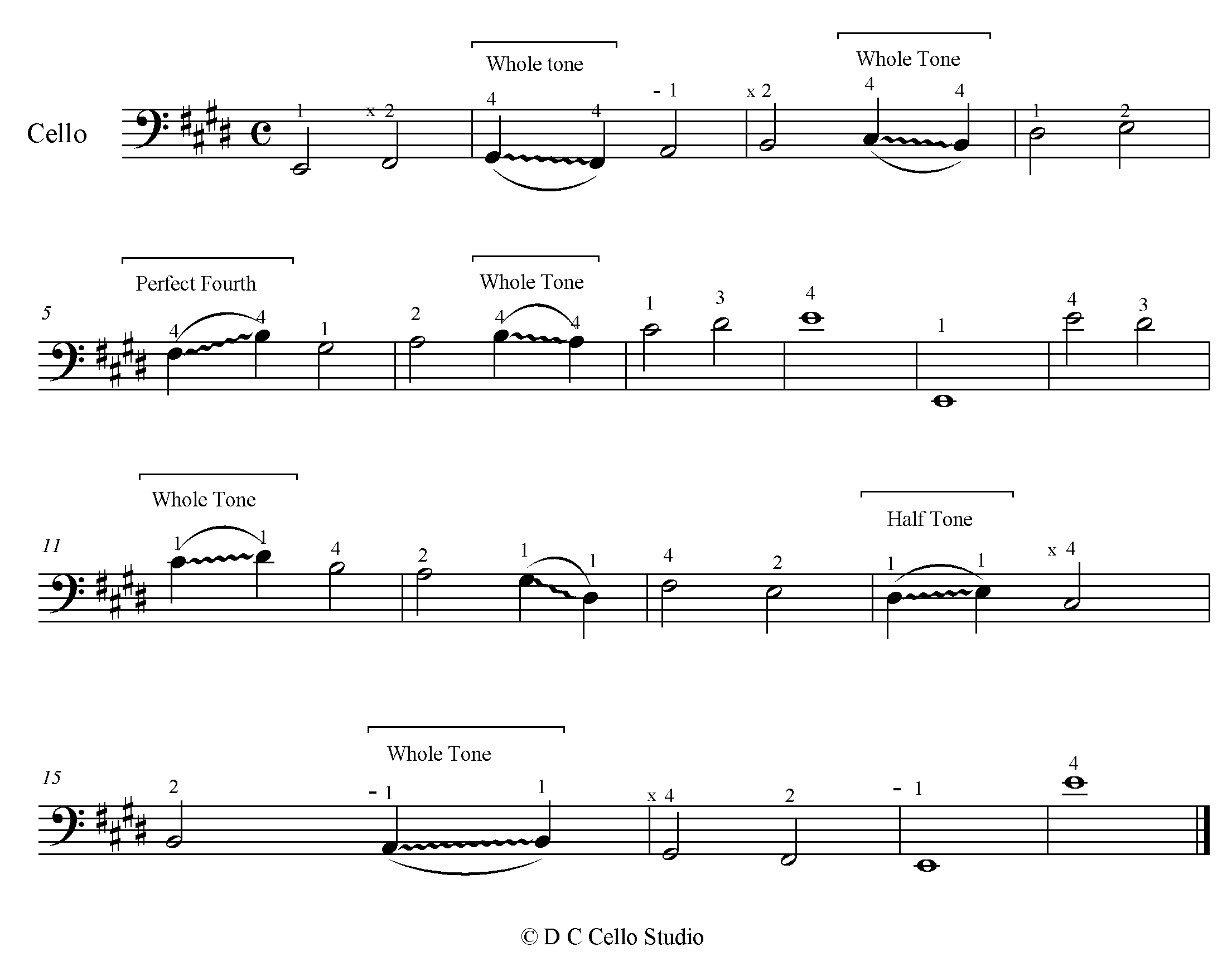
Below are two versions of the scale of F major (two octaves); the first with conventional fingering and the second with a fingering pattern that avoids open strings and happens to be identical to the conventional fingering of E major (two octaves), thus making F major an ideal means of preparing for E major.


In the second fingering pattern, each string cross coincides with a position change. Most students find this confusing at first because with the exception of the shift from first to fourth position on the D string, backward shifts lead to a higher pitch in the ascending scale and visa-versa in the descending scale. So to grow accustomed to this counter-intuitive event, the following exercise can be practised until the left hand knows precisely how to move from one group of notes to the next.

Once you’ve mastered this exercise, you should be able to play the new F major fingering pattern fluently with no obvious gaps at the string crosses. Don’t rush: if you can’t play it slowly, there’s no reason why you’d be able to play it three or four times faster! Learning new shifts and fingering patterns, along with hearing the pitch you’re aiming for before playing it takes time and careful, well-planned practice.
The next step is to apply the F major exercise to the scale of E major as follows.
*The fact that it remains one of the most important and subtly difficult techniques to master is another article entirely!
© D C Cello Studio

Firstly, let’s define three important terms which are easy to get confused and therefore important to be distinguished from each other before exploring how they are related.
1) Key: a family of notes which belong together and have a distinctive sound or “colour”. A key can be major or minor and is represented by a key signature (see definition 2). Every key has 7 individual notes which are represented in the scale (see definition 3) of the key.
2) Key signature: a representation of the accidentals found in a key. These are shown at the start of each stave just after the clef and just before the time signature* and greatly reduce the number of accidentals that have to be shown in the main body of the score**. The order of accidentals in a key signature does not always follow the order in which they appear in the scale. Instead, they follow the order in which they appear from one scale to the next.
3) Scale: a representation of the notes belonging to a key in ascending and descending order starting and ending on the root note of the key. There are 3 main types of scales: major (which represent major keys), harmonic minor and melodic minor (which represent minor keys). Each type follows a specific order of intervals***
* Times signatures, unlike clefs and key signatures, are only shown at the start of the first stave and do not appear again unless there is a change of time signature in the music
** Score: a written or notated representation of music
*** Interval: the pitch distance between 2 consecutive notes (e.g. C – D = a whole tone or major second; C – D-flat = a half tone or minor second)
Understanding major and minor keys and their relationships
The reason there are related major and minor keys is because they share the same key signature. Major keys are easier to understand because they do not deviate from their key signature, and have only 1 scale to represent them. Major scales are based on the following sequence of intervals:
Whole tone; whole tone; half tone; whole tone; whole tone; whole tone; half tone.
So let’s see how that relates to the actual notes of C major:
C – D: whole tone
D – E: whole tone
E – F: half tone
F – G: whole tone
G – A: whole tone
A – B: whole tone
B – C: half tone
Now let’s look at F major:
F – G: whole tone
G – A: whole tone
A – B-flat: half tone
B-flat – C: whole tone
C – D: whole tone
D – E: whole tone
E – F: half tone
So no matter what the key, major scales follow an identical sequence of intervals. This is why they all have different key signatures. In order to follow the same sequence, they have to follow a unique pattern of notes.
Minor keys are more complex than major scales. Every minor key has 2 different types of minor scale as previously mentioned: a harmonic minor scale and a melodic minor scale. Each type of scale deviates from the key signature in a slightly different way.
But let’s forget that confusing fact for a moment and look at how major scales and minor scales relate to each other. Every key signature relates to both a major key and a minor key. The table below shows 3 ascending major scales. The numbers above the scales relate to the steps of the scales. The red note in bold print in each scale is the root note of the relative minor.
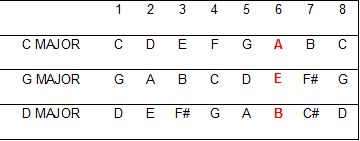
You’ll notice that it is always the 6th step of the major scale that is the root note of the relative minor key. This is the easiest way to find out which minor key shares the key signature of a major key.
In contemporary rock and pop music, we often come across “natural minor” scales (also known as the aeolian mode). These are minor scales that do not deviate from the key signature and take on the following sequence of intervals:
Whole tone; half tone; whole tone; whole tone; half tone; whole tone; whole tone.
This is a (natural) minor, which is related to C major (as you can see in the table above)
A – B: whole tone
B – C: half tone
C – D: whole tone
D – E: whole tone
E – F: half tone
F – G: whole tone
G – A: whole tone
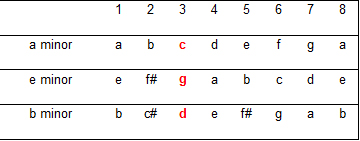
The next table shows the three natural minor scales related to the major scales above. This time, you’ll notice that the bold print red note, which is the root note of the relative major key, has changed to the third step.
In classical music, minor scales are altered in 2 different ways. This gives minor keys a more distinct and defined sound, and distinguishes them from major keys. The first alteration is the harmonic minor scale, in which the 7th step is always raised up by a half tone as shown in a harmonic minor below:
A – B: whole tone
B – C: half tone
C – D: whole tone
D – E: whole tone
E – F: half tone
F – G#: augmented second
G# – A: half tone
The augmented second is the largest interval you’ll find in any classical scale, and is only found in the harmonic minor. Play and listen to the scale several times to hear its distinct sound. The table below shows 3 examples of harmonic minor scales. The altered 7th steps are in bold italic.

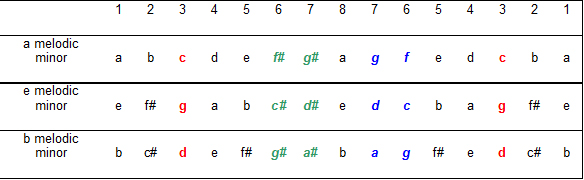
Now for the melodic minor scale, which I like to call the chameleon scale because it changes its colours on the way down. Melodic minor scales raise the 6th and 7th steps by a half tone in the ascending half and lower them back down by a half step in the descending half. This means that the scale has a different sequence of intervals in its ascending and descending halves as shown in a melodic minor:
Ascending
A – B: whole tone
B – C: half tone
C – D: whole tone
D – E: whole tone
E – F#: whole tone
F# – G#: whole tone
G# – A: half tone
Descending
A – G: whole tone
G – F: whole tone
F – E: half tone
E – D: whole tone
D – C: whole tone
C – B: half tone
B – A: whole tone
Note also that the descending melodic minor scale is a natural minor which follows the key signature. Play and listen to the scale, and be sure to hear the difference between the melodic minor and the harmonic minor. The table below shows 3 examples of melodic minor scales. The relative majors are once again marked in bold red; the altered notes in the ascending scale are shown in bold italic green, and the lowered notes in the descending scale are shown in bold italic blue:
The altered notes in harmonic and melodic minor scales are always shown as accidentals within the score, and not in the key signature.
So how do we know whether a piece of music is in a minor key or a major key? First look at the key signature and make sure that you know which major and minor key it belongs to. Then look at about the first 8 bars of the music. If you see any accidentals within the score (not, the key signature – you’ve already looked at that) check what they are. If they happen to be the 6th and/ or 7th step of the minor key, then you can be certain that the music is in a minor key and not a major key. If you see no accidentals within the score, or accidentals that are not the 6th or 7th steps of the minor key, you can be certain of it being a major key.
© D C Cello Studio
© D C Cello Studio
 The Cello Companion