Stretch Position on the Cello

The technique of stretching is one of the great challenges faced by progressing beginner cellists, and must be approached with care and precision. In spite of this it is often neglected or glossed over as a technique, and becomes a real sticking point in left hand technique. When stretch position is not properly studied or understood it causes intonation issues, tension in the left hand and forearm, and is always noticeable to the listener as a technical flaw.

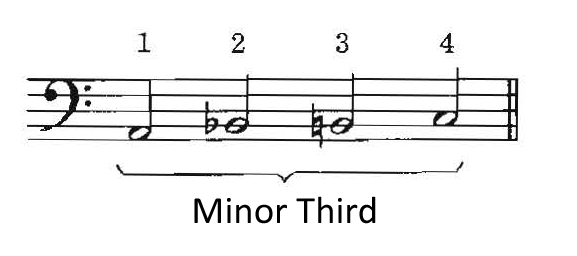
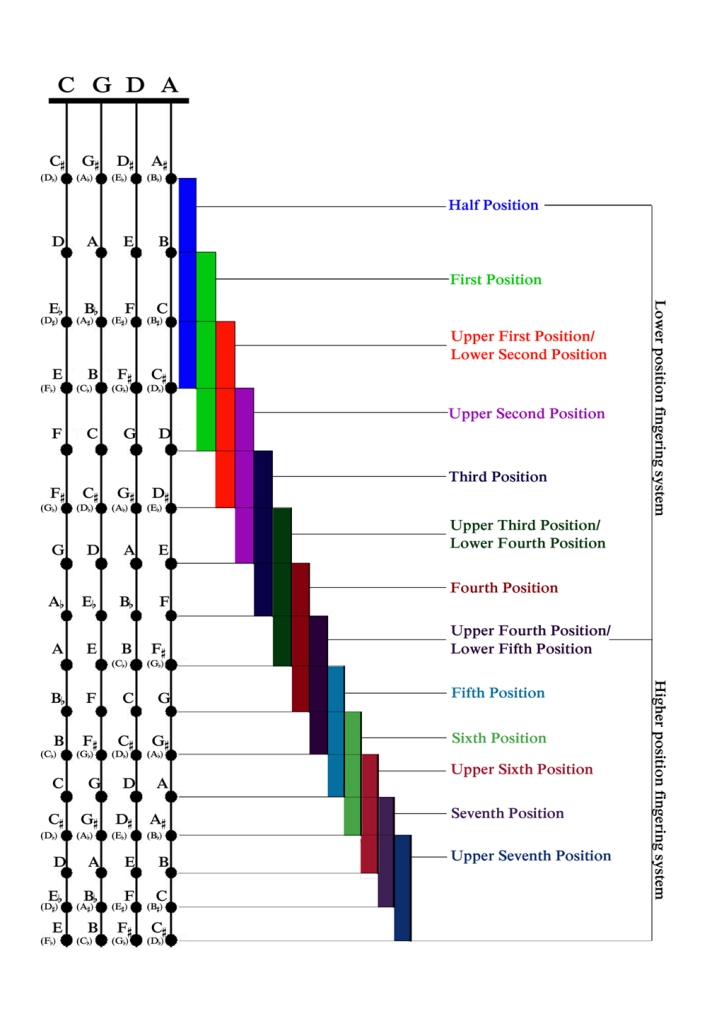
To understand how the stretch works, let’s examine the familiar closed position. Your fingers are placed an equal distance apart and the interval between each is a semitone. The interval from first to fourth finger (on the same string) is therefore a minor third.

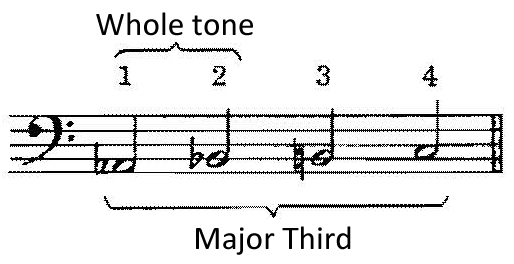
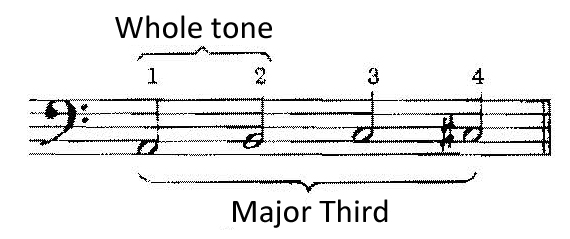
In the closed position we do not have access to the semitones between the open string and first finger; or the fourth finger and the next open string. We reach these by extending backwards or forwards. When in stretch position we also extend the interval between the first and fourth fingers to a major third without having to shift the entire hand forwards or backwards.

As shown in the image below, a backward stretch means that the first finger extends towards the topnut by a semitone while the second, third and fourth fingers remain in place. This means that there is a whole tone between the first and second fingers and semitones between second, third and fourth fingers.
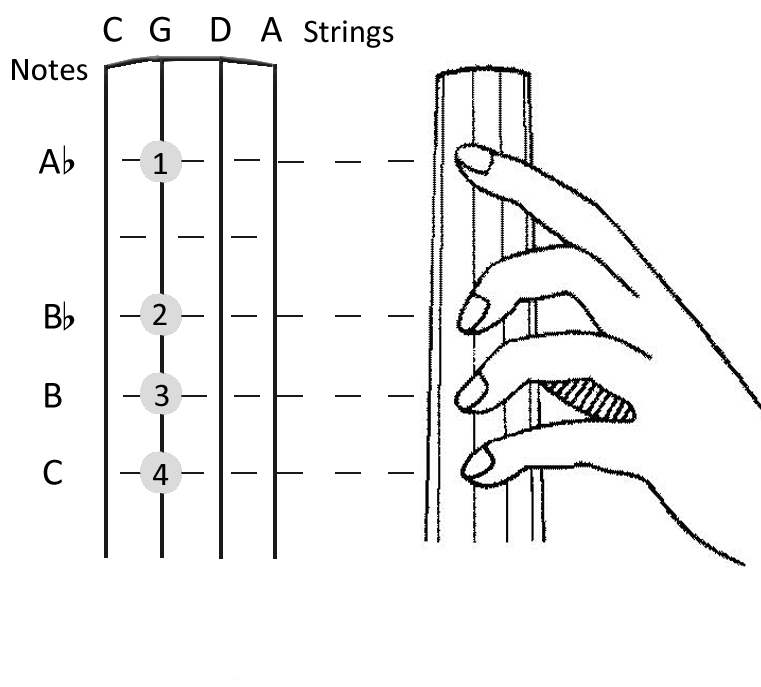
In a forward stretch position, the only finger to remain in place from the original closed position is the first. The second finger extends forwards towards the bridge by a semitone, pushing the second third and fourth fingers forward by a semitone each.
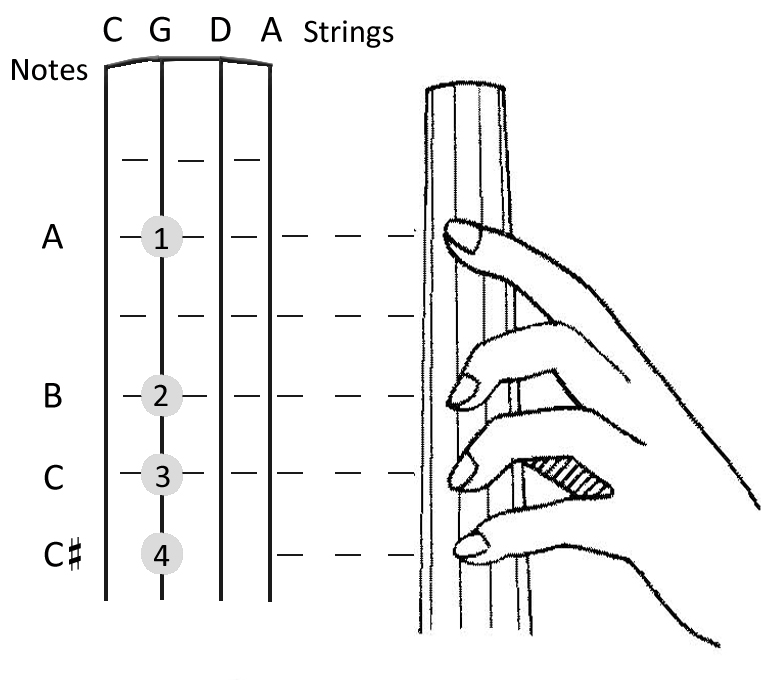
So the only difference between the backward and forward stretch positions is the notes under the hand. The physical position for the fingers and hand is identical. A common mistake among cello students is to extend the fourth finger away from the third to achieve the forward stretch. This should be avoided at all costs – especially for those with smaller hands. The hand simply isn’t built to accommodate a whole tone stretch between the third and fourth fingers for any length of time, especially when playing across two strings or playing in keys that require frequent and prolonged stretches.

It takes time and regular practice to become comfortable with stretch position, but there are a few tips that will greatly facilitate the learning process:

  1. Allowing the first (and largest) knuckle of the index finger to collapse will facilitate the stretch between the first and second fingers.
  2. Allow the thumb to move slightly down the neck (in the opposite direction to the first finger) or let it leave the neck altogether.
  3. Avoid pressure from the thumb at all costs. Smaller hands may find it necessary to release the thumb from the neck altogether – if this facilitates the stretch better, always remember to bring the thumb back to the neck when returning to closed position. To maintain overall stability it is best to have the thumb making gentle contact with the neck at all times.
  4. Allow the elbow to move slightly down and forwards, and keep the shoulder completely relaxed and mobile.
  5. Remember that the stretch is always between the first and second fingers.
  6. Familiarise yourself with and ideally memorise the notes belonging to forward and backward stretches on each string
  7. It is best not to attempt stretching in other positions until you have mastered it in first.

Did you find this post useful? Please consider making a donation.

© D C Cello Studio 2012
Cello Bags and Cases

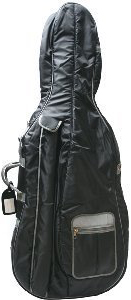
If you purchased a student cello outfit you will already have a bag or even a hard case for your cello. Just like bows, the quality of bags and cases varies a great deal from one outfit to the next, and you may need to upgrade what you have. This is especially important if your cello is doing a lot of travelling with you to and from school or your workplace. A very basic cover with limited or no padding will do little to protect your instrument when it’s in the car, on the bus or train, or being carried around.

The more travelling you do, the greater your need to fully protect your cello with a hard case or very well padded soft case. There is a lot to choose from ranging in price from around £50 to thousands of pounds for professional level flight cases and covers. You’ll be pleased to know that £80 will buy you a very robust and well-made padded bag, which offers a good level of protection for everyday transportation of your instrument.

When choosing a suitable bag or case for your instrument it is also worth considering the weight. If you’re likely to do a lot of walking with your cello, you don’t want a case that will weigh you down and cause back or shoulder ache. 6kg may not sound like much, but add to that the 2.5 – 3 kg of your cello along with your music bag and you’ve got quite a load to carry – especially if your frame is relatively small. Here’s the catch though: entry level cello cases tend to be a lot heavier since they are made out of cheaper materials – usually fibre glass or moulded plastic. Lightweight cello cases are made out of high tech materials such as carbon fibre or carbon composite. These materials are much lighter and extremely tough and durable, but they come at a high price. Unless you have a valuable instrument and are likely to fly anywhere with it, you are unlikely to be looking at this calibre of cello case. You might think that buying a heavy case with wheels is a perfectly good solution, but your cello will not thank you for the bumps and jolts it will get on the majority of road and pavement surfaces, and you certainly won’t be using the wheels up and down stairs.

This is where semi-rigid cases (made out of high density foam or styrofoam) and thickly padded gig bags really come into their own. Styrofoam cases tend to be rather bulky and are often poorly made, but they are lightweight and offer suitable protection for everyday use. When considering padded bags, 11mm of padding should be the absolute minimum.

Here is a list of reliable bags and cases for a tighter budget:

Make: Primavera
Description: 11mm padded cello bag
Price: £50 – £60
Make: Tom and Will
Description: 20mm padded cello bag
Price: £60 – £70
fusionMake: Fusion
Description: 15mm high density foam padded cello bag
Price: £75 – £90
hidersineMake: Hidersine Deluxe
Description:  Deluxe 22mm padded heavy duty cello bag
Price: £75 – £90
Make: Turtle by Gewa
Description: 25mm padded cello bag with wheels
Price: £100 – £125
excaliburMake: Excalibur
Description: High density foam semi-rigid cello case
Price: £110 – £130

If you’re planning to fly anywhere with your cello you’ll need to invest in a good quality case. The bad news here is that even the very best cases sometimes fail to fully protect instruments on airlines. There is always an element of risk when you fly with your cello, and you should always check your options with the airline or travel agent before you fly anywhere. The same applies to any other form of long distance travel that does not allow you to take your instrument on board with you.

The following is a list of more robust cello cases worth considering if you’re planning to do any long distance travel with your cello or you’ve invested in a good quality cello:

Make: Archer by Gear4Music
Description: Durable fibreglass case weighing 7.6kg
Price: £140 – £150
Make: Hiscox (Lifelite Standard)
Description: Double moulded construction weighing 5.2kg
Price: £175 – £210
Make: Sinfonica
Description: Fibreglass case with interior instrument suspension weighing 4.9kg
Price: £240 – £280
Make: Bam Classic
Description: Extra-durable ABS layer with full foam-injected interior suspension weighing 5.4kg
Price: £340 – £370

Did you find this post useful? Please consider making a donation.

© D C Cello Studio 2012
 

2011 in review

The very clever folks at WordPress.com have compiled this lovely report detailing The Cello Companion’s reader and blog statistic for 2011.

Thank you for reading, subscribing, sharing and making this blog a success. I hope 2012 is a fantastic year full of musical inspiration for all of you and I hope this blog continues to inform and entertain. I welcome ideas and suggestions for new posts, so if you have any please post them here!

Here’s an excerpt:

The concert hall at the Syndey Opera House holds 2,700 people. This blog was viewed about 29,000 times in 2011. If it were a concert at Sydney Opera House, it would take about 11 sold-out performances for that many people to see it.

Click here to see the complete report.


© D C Cello Studio 2012