Did you find this post useful? Please consider making a donation.
© D C Cello Studio 2012
String crossing and shifting are two fundamental techniques that present stumbling points on their own. Put them together and they can become an unfortunate blemish in an otherwise good performance. Without the necessary co-ordination between the left and right sides which are performing different physical tasks and a thorough understanding of the positions visited, this particular technique will lack good tone and accuracy of rhythm and intonation. Amazingly, it is all too often skimmed over by teachers who assume that if their students are reasonably capable of each individual technique they will easily be able to combine them. Just because I can easily pat my head and rub my belly doesn’t necessarily mean I can perform both actions simultaneously!
The first step towards mastering any technique is to understand why it exists and what it will enable you to do. The simultaneous string-cross and shift presents itself in two particular situations. The first of these and typically the first time we encounter the technique in our study of the cello is when we play in more remote keys which eliminate the use of some or all of the open strings. The second is when we need to avoid open strings in order to play sustained passages with consistent tone and vibrato or to avoid awkward string crossing in faster passages. One of the great advantages of being able to manage this technique well is the significant increase in potential fingering patterns that become available, which means that we have a much better and more varied sound palette at our disposal.
Most of us first encounter the need to shift and cross in scales: most notably, E Major. However students who play with orchestras frequently come across techniques they have not yet covered in their lessons and this is often one of them. To me it has always made sense to introduce the technique earlier on – while the neck positions are being studied – using home key scales such as F and D majors (two octaves) thus giving the student and early introduction to alternate fingering patterns and making remote keys far less daunting to play and sight-read. All it takes to comfortably manage a piece, study or exercise in a key with four or more sharps or flats is a sensible fingering pattern and the instinct to determine where extended positions are required – a simple matter of knowing where you are in the given scale.
I believe the reason it is easier to learn scales such as D or F majors with fingering patterns that avoid open strings is simply that they are already familiar territory. Furthermore, there are open string targets available to test intonation along the way. Any student who has been introduced to the first four positions on the cello should be comfortable with major keys containing up to three sharps and two flats, and minor keys with two flats and one sharp. They will also have covered extended positions; and string-crossing* is one of the first techniques we are introduced to on the cello. By combining these techniques we can introduce the valuable technique of simultaneous shifting and string crossing to avoid open strings.
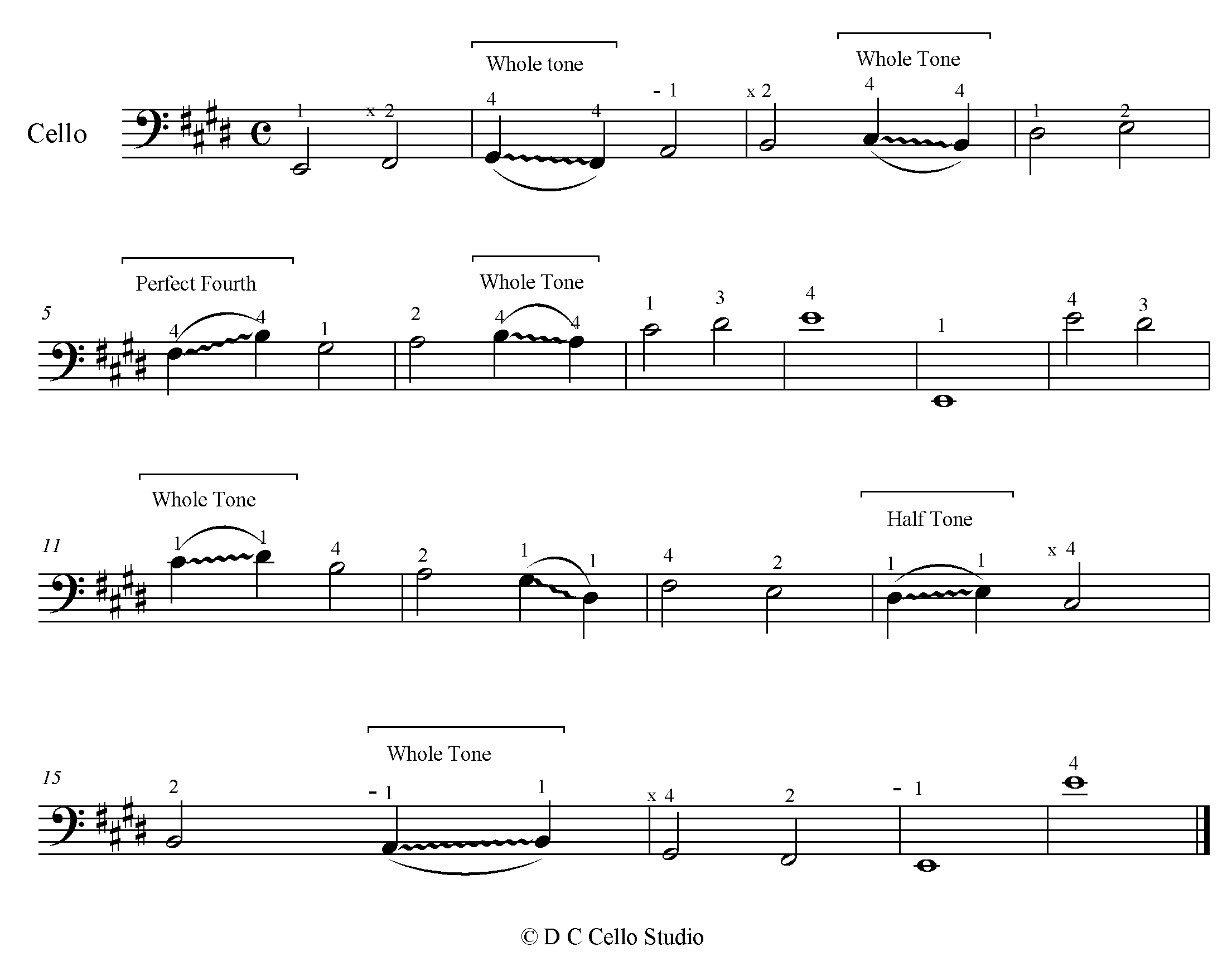
Below are two versions of the scale of F major (two octaves); the first with conventional fingering and the second with a fingering pattern that avoids open strings and happens to be identical to the conventional fingering of E major (two octaves), thus making F major an ideal means of preparing for E major.


In the second fingering pattern, each string cross coincides with a position change. Most students find this confusing at first because with the exception of the shift from first to fourth position on the D string, backward shifts lead to a higher pitch in the ascending scale and visa-versa in the descending scale. So to grow accustomed to this counter-intuitive event, the following exercise can be practised until the left hand knows precisely how to move from one group of notes to the next.

Once you’ve mastered this exercise, you should be able to play the new F major fingering pattern fluently with no obvious gaps at the string crosses. Don’t rush: if you can’t play it slowly, there’s no reason why you’d be able to play it three or four times faster! Learning new shifts and fingering patterns, along with hearing the pitch you’re aiming for before playing it takes time and careful, well-planned practice.
The next step is to apply the F major exercise to the scale of E major as follows.
*The fact that it remains one of the most important and subtly difficult techniques to master is another article entirely!
© D C Cello Studio

I specifically chose the word “supporting” rather than “holding” in the title of this section, and you may be wondering why. The simple reason is that holding things often implies grasping or clutching, neither of which promote pain free, well balanced technique. Most people playing the cello for the first few times notice an overwhelming tendency to hold it by squeezing their knees against it and using one or both of their hands to steady it. By creating an accurate mental image and understanding of how to interact with your cello from the earliest possible stage, you have a much better chance of laying a solid foundation for great cello technique.
Now that you’ve explored your ideal sitting posture and the concept of balancing on your seat, you’re ready to bring your cello into the equation. Your first task is to pull out and fasten the spike, and you’ll want to know precisely how long it ought to be. The answer is annoying, but get used to it because you’ll be hearing it a lot in response to pertinent questions about playing the cello: It depends. You see, it’s not only your height that will influence the length of your spike; it’s the length of your legs, your torso, your arms and your seat. Then there is the terribly inexact science of personal preference, which will take a while to discover. As a rough guide: when you are sitting with your cello, the C tuning peg (the lower right-hand peg) should be level with or just behind your left ear. If you feel as if the cello is pushing you backwards and it seems to hobble around just above your knees rather than rest between them, the spike is too long. Conversely if the angle of the instrument is too vertical, the spike is too short. You will find yourself experimenting with different lengths for a while in the early stages. When you have found a length that works for you, use a permanent marker to make a small mark on the spike. This will avoid wasting time lengthening and shortening it before you can settle into your practice sessions.
As I have already pointed out, your cello should rest against you, supported by your posture as opposed to gripped and held in place. By placing your feet roughly in line with your hips and turning your toes out, you will find that your knees can fall further apart without creating any tension in your thighs. This also creates more surface area for the lower half of the cello to rest against and ensures that the instrument won’t move about as soon as any weight is applied to it from the bow or left hand. It helps to think of creating a nest with your legs for the cello to lie in – well supported but not squeezed or gripped. The left hand side of the cello should be slightly higher so that the A string is turned inwards towards the bow or plucking hand. The lower ends of the C-bouts (the c-shaped curves forming the cello’s narrow “waist”) should be just above or at the top of your knees. Placing your left foot slightly in front of your left foot will help to achieve the subtle angle necessary for comfortable bow technique. The upper end of the cello body should rest very lightly against your sternum; the bulk of the instrument’s weight being supported by your knees. An excellent and very simple way to test whether your cello’s weight is correctly distributed is to lean slightly backwards away from the instrument. If it follows you and stays against your chest, you haven’t quite created that nest it needs between your knees. If the cello stays where it is and feels secure, you’ve got it! Now check the mobility in your hips: you should be able to turn your upper body around by a few degrees to either side from the hips. Make sure you’re not just twisting your shoulders and upper back – it needs to be your entire torso.
To help you make your cello part of your body space as you sit with it as opposed to an external and rather awkward object, put both arms around it and give it a hug – even if it makes you feel a little silly. You need to bond with the instrument physically, mentally and emotionally. The latter two happen with time and practice, but won’t happen without the former.
© D C Cello Studio
One of the most daunting aspects of starting out as a private instrumental teacher is finding your first students – especially if there are already several established teachers in your area. The good news is that there are a number of effective ways to advertise your service. The less cheerful fact is that that you are highly unlikely to acquire a vast number of students overnight, or get enquiries from intermediate or advanced players until you have built up a reputation. It is important not to adopt the attitude that teaching beginners is somehow a “lesser task” than teaching more advanced students. It is teachers who can transform their students from barely knowing how to hold the instrument to playing it competently and artistically who become oversubscribed and have the luxury of picking and choosing their students.
So how does one go about finding these students in the first place?
INTERNET ADVERTISING
The Internet has become so integrated into our everyday lives it really is hard to think of how we managed without it. All businesses with very few exceptions use the Internet in some capacity to attract new customers. Music teachers are no different, and there are three main ways in which we can exploit the online world without needing anything more than novice computer skills: online music teacher directories, classified websites and dedicated websites.
For private music teachers there are literally hundreds of online directories dedicated to advertising music lessons. Unlike Internet resources for promoting music, which are littered with scams and rip-offs, the vast majority of music lesson websites are trustworthy if not all hugely effective. They tend to follow a similar model, offering a basic free listing or a paid listing which offers the ability to add additional information and a picture or two; and comes up first in all relevant search results. These fees tend to be charged as an annual subscription which varies, but is normally a fairly modest amount. In the interest of getting noticed, it is worth paying for one or two featured listings, but don’t expect your phone to be ringing off the hook as a result.
There are several elements you should examine when signing up to one of these sites. Try to determine how popular it is – look at how many teacher listings there are and look for testimonials from users of the site – both teachers and students or students’ parents. Run a search for the site using basic keywords in popular search engines such as Google or Yahoo to see how well the site ranks. If it doesn’t show up amongst the first 5 – 10 results, it has much less chance of being found by prospective students. Keywords should be along the lines of “music teacher directory” or “find music teachers”. You can also be more specific and include the instrument you teach amongst your keywords – you may find some good specialist sites dedicated to your instrument or the family your instrument belongs to. Examine the site thoroughly and see that it runs smoothly and efficiently, is easy to use and has adequate search capability. Try to look at it from the perspective of someone seeking lessons for themselves or their child. If you’re searching for a piano teacher based in South London and your search pulls up trombone teachers based in Glasgow, you’re likely to abandon the site before you find what you’re looking for. Here is a list of reliable and popular UK-based teacher directories and classifieds:
This is a highly user-friendly site with over 5000 teacher listings. The site also has very useful free resources for teachers ranging from articles on a variety of teaching issues, music curriculum material, manuscript paper and a page of useful links to other music and teaching-related sites. The cost of a premium listing is currently £12.99 per annum. Basic free listings are also available with no images or external links.
2. www.musiclessonsonline.co.uk
MusicLessonsOnline is a well-designed site which is incredibly easy to navigate and is very well geared towards students with a wealth of useful information. Articles include information on the cost of music lessons, finding an instrument, the difficulties faced by beginners and how to overcome these, and background on music history and theory. Featured listings cost £9.95 per annum and free listings with no images or external links are available.
This is a directory for private tuition in a number of disciplines including music. The Tutor Pages has an interesting and unique model. In order to get a listing, you are required to submit a specialist article which is featured in your listing and included in the site’s information library. This is a great way to impress potential students and to get your creative teaching juices flowing. There are no free listings available, but profiles are very comprehensive with a “Q & A” section and the ability to upload documents like testimonials, your CV and more articles if you wish. Each profile is assigned a unique website address, making it much easier to be found on Google. The annual subscription fee is £19.50.
Vivastreet is a general classifieds website and is free to use. There is a section dedicated to music lessons. Listings can include pictures and a link to your website if you have one. Although the site is not dedicated to music education, listings tend to rank highly on search engines and can be refreshed every week to make them easy to find.
Partysounds is a musician finder website and has a section dedicated to music teacher listings which are also free of charge. There is no facility for uploading images, but you can link to your website or a more comprehensive teacher profile.
6. www.yell.com
Everyone is aware of yell.com, the online version of the Yellow Pages directory. For that reason alone, it’s a good place to list your service – it gets a phenomenal amount of traffic. Yell does offer very basic free listings and unless money is no object for you, don’t consider paying for a more detailed and visible one. Furthermore, if you register a free listing, expect sales calls from them in attempt to get you to pay for a featured online listing or a Yellow Pages listing.
The above list is by no means comprehensive. There are many more sites worth exploring and the more you list your services on, the more your name will get noticed and associated with your instrument. Although there is very little chance of any of these sites being fraudulent, there are scamsters who target them. If you receive an unusual request – especially something that just seems too good to be true, you can rest assured it probably is. A recently popular scam involves tricking teachers into thinking they’re taking on a student for intensive lessons over a relatively short period – something like 5 lessons a week for 1 month. They will be asked to give a quote for this, and will be given an elaborate story about the student, who apparently comes from a foreign country but is visiting a relative in the UK and wishes to take music lessons while they are there. Should you take the bate and agree to teach them, you will then be given another elaborate story regarding the payment, which will go something like this: the student will be needing money to live off whilst they are in the UK, and you will be receiving a cheque for an amount that far exceeds the amount you have quoted. You will be told to keep the amount you quoted and withdraw the balance to give to the student. If you do this, you’ll find that the cheque has bounced, the student has disappeared without a trace and you have been defrauded of a substantial sum of money.
This particular scam is now fairly well documented and therefore less likely to happen, but there are many like it circulating the Internet, and it always pays to be vigilant. Any enquiry that doesn’t seem quite right probably isn’t, so trust your intuition. Be wary of how many personal details you share on your profile – an email address is sufficient for people to contact you in the first instance.
Having your own website can be excellent additional advertising but unless you have a fairly large budget to pay for it to be professionally designed and optimised to rank at the top of search engines it serves more as a brochure to direct people who have already found your details to than a means of finding new students. The cost of registering a domain name (i.e. http://www.yoursite.com) and hosting a website has come down so dramatically over the past few years that it has become a viable and affordable option for small businesses and freelancers. Having your website professionally designed can be pretty expensive, but with the much improved quality of easy-to-use website templates and web building software there is no need to pay someone to do it.
Social networking sites make a great alternative to having your own website and don’t cost anything at all. You can upload music and videos such as footage of a lesson you’ve taught that you have permission to use or something inspirational featuring your instrument from YouTube. You can also encourage existing students if you have any or colleagues to leave positive comments about you.
OTHER MEANS OF ADVERTISING
There are many other things you can and should do to get your name out there and acquire precious students. As previously mentioned, you may live in an area that already has numerous well-known teachers of your instrument. Although this is a daunting prospect, you can make it work to your advantage. Introduce yourself to them – ideally in person – and let them know that you are actively looking for students. Ask them to pass on any students they are unable to or would prefer not to take on. Some may already have a preferred teacher to take on their overflow, but it never hurts to ask, and striking up positive dialogue with experienced teachers has many other benefits. They will almost certainly be willing to offer advice when you need it, and may even be willing to watch a lesson or 2 of yours and provide you with valuable feedback. It is also worth introducing yourself to teachers of instruments in the same family as yours. Often their students will have a younger sibling who wishes to (or whose parents wish them to) learn your instrument.
There are plenty of old-fashioned advertising methods that are still perfectly adequate. Make sure that all of your local music shops know about you, and if they will allow it, ask them to put up a post card or poster in their shop window for you. Some charge a nominal fee for this, but nothing that will break the bank. You should also make yourself known to independent instrument makers and/ or repairers. Look around your local area for notice boards that you could post an advert on, see whether you can leave fliers at your local library and even consider putting up an advert in the window of your newsagent. These are all free or very inexpensive ways of getting your name about.
Although most schools use peripatetic instrumental teachers checked and supplied to them by their local authority, not all independent schools do. They are worth getting in touch with to discuss making their pupils aware of your service. You can ask them to mention this in their newsletter, let you put up a poster on their notice board or get their music co-ordinator to mention you to pupils already taking music lessons. You could even suggest that you visit the school to give the pupils a brief demonstration of your instrument. Be advised that unless you have an enhanced CRB certificate, no school private or otherwise is likely to recommend you.
Finally, you might consider paying for a listing in a business directory. Depending on the size and distribution of the directory and the amount of space your advert takes up, the cost can vary from reasonable to extortionate. The best known of these is the Yellow Pages, and they do not fall into the reasonable price category. They do offer a few additional services such as a dedicated 0845 number which tracks the number of calls you get. This is all very well, but from my experience the cost does not justify the number of students you actually end up acquiring. I have had better results with free online classifieds than I did with the Yellow pages. The smaller local directories of which there are many offer a more reasonable price and some actually hit a much better target. Overall, business directories are considerably more expensive than most online advertising and the results they produce can be a bit hit-and-miss. They also tend to nag a lot when your listing is approaching its expiry date.
CONCLUSION
So which of these advertising and search methods is the best? Simply put, they all have advantages, some have a few points to watch out for, and not one is a magic quick fix. So try them all – get your name known in your area as far and wide as possible. The real advertising starts when you achieve good results with your students. They will often be asked who their teacher is and if their parents are happy with their progress and see that they are enjoying their lessons, they will inevitably talk about you to others. But you have to get there first, so get online, get those posters and post cards printed and up in the shop windows and start chatting to other teachers in your area. Good luck!
© D C Cello Studio
 The Cello Companion