My regular readers may recall my previous post on warming up. Whether you’ve read it or not, I’ll not be repeating myself, except to remind you of the importance of warming up before you launch into your practice session. It makes no difference what level of playing you’ve achieved – warming up is about being kind to your body and ensuring healthy playing habits. The following exercises were devised for some of my students whose practising habits needed improvement. The students in question are at very different stages in their technical development, but the exercises have made a noticeable difference to all of them. For anyone who is either unconvinced of the importance of warming up, or uncertain of how to, these exercises are for you. What you will come to realise is that not only do they make a difference to the comfort and success of each practice session; they make a difference to your overall progress. No matter where you are in your technical and musical journey, you will always benefit from revisiting basic technical cornerstones: bow control, string crossing, left hand stability, and agility. If you’re new to doing more than a cursory scale or two to warm up, try these and keep a diary to monitor the difference they make. Not over a few days or a week, but over several months or a year.
At least two of the following warm-ups (one for left hand, one for bow) should be done at the start of every practice session. Rotate them to ensure that all are covered.
1. Open String Bowing
Set the metronome to 100. On each string play the following:
i. 4 bows with 8 ticks per bow
ii. 4 bows with 12 ticks per bow
iii. 4 bows with 9 ticks per bow
iv. 4 bows with 6 ticks per bow
Points to remember:
- Bow hold: always check before you start. Relaxed, soft hand; no pressing with the thumb; use the WHOLE arm from shoulder blade to fingertip.
- On the string: 90˚ angle between the string and the bow AT ALL TIMES; always halfway between the bridge and the fingerboard.
- Don’t change the speed or weight while bowing – keep the sound as EVEN as possible.
- Do you like the sound? If not, why not? Always aim to make the very best sound you can.
2. Left Hand Pizzicato
Set the metronome to 120. On each string, pluck with the left hand fingers one finger at a time, one metronome tick per pluck in the following orders:
i. 1st, 2nd, 3rd, 4th
ii. 4th 3rd, 2nd, 1st
iii. 1st, 3rd, 2nd, 4th
iv. 4th, 2nd, 3rd, 1st
Points to remember:
- Keep the left hand in exactly the same position you would if you were playing in first position – fingers curved and spaced away from each other; thumb RELAXED and only touching the neck.
- Keep the thumb touching the neck when the finger pulls away from the string – the left hand must remain stable and in the same place throughout the exercise.
- Keep the sound of each pizzicato even and clean; avoid bumping next-door strings.
- Keep the tempo very stable. If 120 is too fast, try at a slower speed and gradually work your way up to 120.
3. String Crossing (separate bows)


Points to remember:
- All points from “Open String Bowing”
- Use the whole bow for minims.
- Use half the bow for crotchets. Practise the crotchet exercise in the LOWE HALF of the bow and the UPPER HALF of the bow.
- Use around a quarter of the bow for the quavers and play towards the MIDDLE of the bow.
- Adjust the bow when crossing strings so that you always maintain a 90˚ angle.
- Turn your whole upper body around from the hips to get to the A string. DON’T lift the right shoulder.
4. Finger Press-ups
i. Sit at a table or desk with a good cello posture
ii. Place your left hand flat on the table directly in front of you with your fingers a small distance apart from each other (just like they would be in first position on the cello), keeping your arm heavy and completely relaxed
iii. Very slowly begin curving your fingers so the fleshy tips are on the table
iv. Keeping your shoulder relaxed and down and your fingers curved with the tips on the table, slowly lift your hand and arm so that you can feel the weight of your arm being transferred into the fleshy tips of your first, second, third and fourth fingers. Your thumb should be relaxed and gently touching the table.
v. Transfer the weight of your arm from one finger to the next beginning with the first finger and finishing with the fourth finger.
vi. Relax and flatten the hand again
vii. Repeat the exercise several times; imagining the cello string being trapped underneath the fingers each time the arm is raised.
Points to remember:
- Maintain a true cello posture throughout the exercise: sit tall, keep your head on top of your body, and keep shoulders completely relaxed.
- Left hand fingers must remain curved and FIRM but NOT STIFF – imagine holding a raw egg in your hand.
- Keep your feet flat on the floor underneath your knees. Do not pull your heels off the floor, or your feet underneath the chair.
5. String Crossing (with slurs)
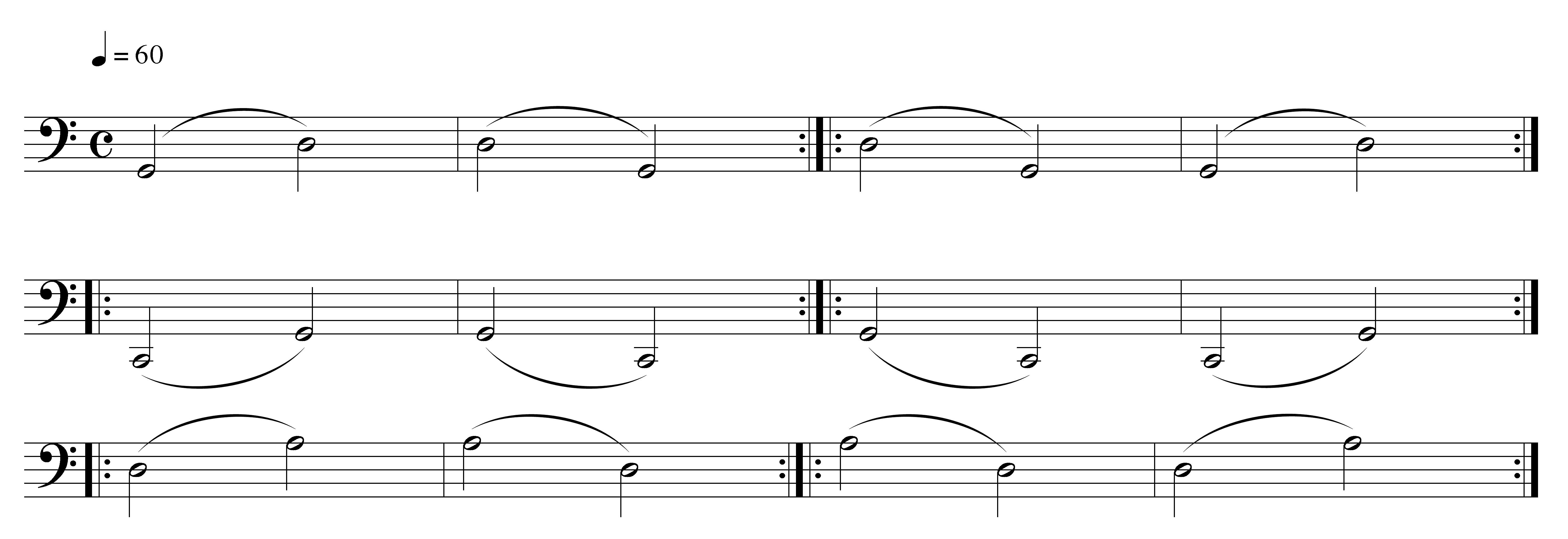


Points to remember:
- All points from “Open String Bowing” and “String Crossing (separate bows)”
- Slurs must be LEGATO and CLEAN (i.e. very smooth string crossing with no scratches or “holes” in the sound)
6. Left Hand Agility

Points to remember:
- Curved fingers falling down from the top knuckle
- Thumb: relaxed, touching the neck, NO PRESSING
- Straight line from hand to elbow – no bend in the wrist
- Stable unmoving hand – only the fingers should move
- Keep fingers OVER THE STRING at all times – no curling under the hand
- Repeat these exercises on the D, G and C strings
© D C Cello Studio
 The Cello Companion