Effective Practising: Making the Most of Your Time

Whether you’re studying music and devoting many hours to practising and playing, or a keen amateur with a full time day job, a family and very limited time to practise, it really is essential that you use your available time as productively as possible.

Making the Most of Your Time

I remember my music college days, when many of the first year students (myself included) suffered from a terrible condition: eight-hours-a-day syndrome. When we weren’t in classes, we could all be found in our practice rooms furiously hammering the most challenging studies, sonatas and concertos in our repertoire, desperately trying to outplay each other. Every now and then one of us would stumble out of a practice room looking like a rabbit caught in the headlights, and outside you would always come across a couple of us nervously chain-smoking and discussing the terrifying notion of our lessons – only two or three days away. Very few of us were spending quality time locked behind those sound-proofed double-doors. We were far more focused on “doing time”, and being able to proudly boast about the seven or eight hours we’d spent turning ourselves into nervous wrecks.

Not long after I started at music college, my teacher made what I thought was a radical and utterly ridiculous statement: that it was not possible to put in more than four genuine hours of practice a day. The rest, she said, was just playing. That can’t be right, I thought: everyone here seems to practice for at least six hours a day. And they all seem to be practising – going through their Kreutzer and Popper studies in minute detail, repeating the same two bars for anything up to an hour at a time. Surely that was practising? It must be, because the students who took that approach were very good, and very intimidating. If it worked for them, I was determined it was going to work for me too! By the last quarter of my first year I was rewarded for my manic practice routine – not with the effortless, impressive technique I had expected it  would produce, but with persistent and painful tendinitis. Being inclined towards and surrounded by melodramatic attitudes, I took myself off to doctors, physiotherapists, homeopaths and counselling. Cortisone injections, therapeutic massage, herbal remedies, sage advice: some brought temporary relief, some nearly convinced me that the problem had disappeared and some made not the slightest difference. For the next year I was plagued with injury, finding myself unable to play for weeks and sometimes months at a time. It wasn’t until I started thinking back to my teacher’s wise words about practice and considering what she really meant that I started to overcome my tendinitis. It wasn’t simply a matter of cutting back on the number of hours I spent in my practice room. I began to realise that I needed to get a lot more forensic about what was wrong with my technique, and stop bucking against my teacher’s insistence that certain fundamental techniques such as my bow hold, my posture and how I held my instrument needed serious attention.

At the other end of the spectrum are those aspiring cellists whose time is taken up with a challenging career (not connected to playing the cello) and often also a busy family and social life. It’s hard enough finding an hour in the week to squeeze in a cello lesson, so where on earth is that hour a day for cello practice going to come from? Many of my students face this problem and it is often a source of frustration for them. They sheepishly tell me how little practice they’ve managed this week as they unpack and tune up their cellos. While all of these students have very different lives: different careers, different working hours, different family commitments; they all tend to have one thing in common: they admit to sitting vacantly in front of the telly most evenings when they know they could be using some of that time to practise. I understand why they don’t: I’ve had my own brief experience with the nine-to-five corporate lifestyle, and I remember how  exhausted I felt at the end of my working day. I spent many of my evenings half-asleep or snoring in front of the TV, and at times my cello was like a distant memory. I realised that getting into a regular practice routine required me to set aside time for my cello that was sacred. No matter how tired I thought I was, no matter how much I thought I wanted to watch a certain program, however pressing my need to take myself off to my local for a pint seemed, for that time my cello needed to be the undisputed priority. It was difficult at first – like trying to get back into an exercise routine after a holiday of relaxation and culinary indulgence. But after a couple of weeks I found myself looking forward to my sessions, even when I felt bone-weary to start with. I was feeling a positive difference in my playing and I felt energised by the time I had tuned my cello and begun warming up. It didn’t work absolutely every night, and I also learnt to tell the difference between feeling superficially tired and being so exhausted that it was better to call it quits.

Changing my understanding of what practising means saved me from giving up on playing the cello on more than one occasion. The psychological and emotional aspects of this transformation, as fascinating as I find them, are a topic for an entirely new article. For now let’s focus on what makes a practice session truly productive. I’ve already discussed the importance of warming up, and in that article I touched on the benefit of using warm-up exercises that serve to improve fundamental techniques such as sound, bow control and vibrato as well as getting us physically prepared for a practice session. Once your warm-up is complete, these are useful points to consider in terms of how to structure the rest of your session:

  • In the pieces you’re playing, what are the main technical challenges? Don’t just think about the bars that tend to trip you up and settle for playing them over and over again. While repetition certainly can be a valuable learning tool, it only works when you know what you’re repeating and why. Analyse what happens in those troublesome bars: are there unexpected string crosses? Is there a position change you’re struggling with? Perhaps there are complex events for both the bow and the left hand and you’re struggling to co-ordinate them. Whatever your conclusions, find some exercises and studies that focus on these technical challenges.
  • If you play in an orchestra or chamber group, what aspects of your playing do you think holds you back the most in this activity? Perhaps you’d like to improve your vibrato, or you freeze every time you see a trill above a note. Whatever the technical shortcoming, there’s an exercise for it. Make a list of the things you’d like to improve and ask your teacher to help you find suitable exercises and studies. Remember that in order to give your body the chance to learn the necessary movements that each technique involves, you need to work SLOWLY at first.
  • If you’re planning to spend your session working on one of your pieces, think back to the last time you played it. Were you able to play the whole piece at the recommended tempo or did you find yourself slowing down in the sections you find more challenging? If you’re slowing down in parts, you need to bring the overall tempo down relative to those sections. You’ll also do well to spend more time working on the tricky sections and less time playing through the bits you’re more confident with. As obvious as this sounds, it’s a common issue and worth mentioning. When I get my students to think back on what they spent most of their practice hours on, they often realise that it was the sections they felt more confident with rather than those that they knew were giving them trouble. This is not to say that no time should be dedicated to playing pieces you know you can play well – it’s a good boost to your confidence and generally good for the soul. But pay attention to just how much time you spend doing this and try to balance your sessions with good developmental work.
  • Don’t forget to cool down and stretch at the end of your session.

I’ll be writing more about this soon.

Did you find this post useful? Please consider making a donation.

© D C Cello Studio 2011
A Beginner’s Guide to Keys in Music

Firstly, let’s define three important terms which are easy to get confused and therefore important to be distinguished from each other before exploring how they are related.

1) Key: a family of notes which belong together and have a distinctive sound or “colour”. A key can be major or minor and is represented by a key signature (see definition 2). Every key has 7 individual notes which are represented in the scale (see definition 3) of the key.
2) Key signature: a representation of the accidentals found in a key. These are shown at the start of each stave just after the clef and just before the time signature* and greatly reduce the number of accidentals that have to be shown in the main body of the score**. The order of accidentals in a key signature does not always follow the order in which they appear in the scale. Instead, they follow the order in which they appear from one scale to the next.
3) Scale: a representation of the notes belonging to a key in ascending and descending order starting and ending on the root note of the key. There are 3 main types of scales: major (which represent major keys), harmonic minor and melodic minor (which represent minor keys). Each type follows a specific order of intervals***

* Times signatures, unlike clefs and key signatures, are only shown at the start of the first stave and do not appear again unless there is a change of time signature in the music

** Score: a written or notated representation of music

*** Interval: the pitch distance between 2 consecutive notes (e.g. C – D = a whole tone or major second; C – D-flat = a half tone or minor second)

Understanding major and minor keys and their relationships

The reason there are related major and minor keys is because they share the same key signature. Major keys are easier to understand because they do not deviate from their key signature, and have only 1 scale to represent them. Major scales are based on the following sequence of intervals:

Whole tone; whole tone; half tone; whole tone; whole tone; whole tone; half tone.

So let’s see how that relates to the actual notes of C major:

C – D: whole tone

D – E: whole tone

E – F: half tone

F – G: whole tone

G – A: whole tone

A – B: whole tone

B – C: half tone

Now let’s look at F major:

F – G: whole tone

G – A: whole tone

A – B-flat: half tone

B-flat – C: whole tone

C – D: whole tone

D – E: whole tone

E – F: half tone

So no matter what the key, major scales follow an identical sequence of intervals. This is why they all have different key signatures. In order to follow the same sequence, they have to follow a unique pattern of notes.

Minor keys are more complex than major scales. Every minor key has 2 different types of minor scale as previously mentioned: a harmonic minor scale and a melodic minor scale. Each type of scale deviates from the key signature in a slightly different way.

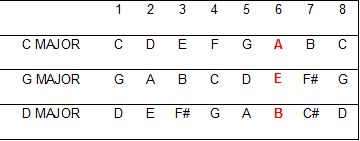
But let’s forget that confusing fact for a moment and look at how major scales and minor scales relate to each other.  Every key signature relates to both a major key and a minor key. The table below shows 3 ascending major scales. The numbers above the scales relate to the steps of the scales.  The red note in bold print in each scale is the root note of the relative minor.

You’ll notice that it is always the 6th step of the major scale that is the root note of the relative minor key. This is the easiest way to find out which minor key shares the key signature of a major key.

In contemporary rock and pop music, we often come across “natural minor” scales (also known as the aeolian mode). These are minor scales that do not deviate from the key signature and take on the following sequence of intervals:

Whole tone; half tone; whole tone; whole tone; half tone; whole tone; whole tone.

This is a (natural) minor, which is related to C major (as you can see in the table above)

A – B: whole tone

B – C: half tone

C – D: whole tone

D – E: whole tone

E – F: half tone

F – G: whole tone

G – A: whole tone

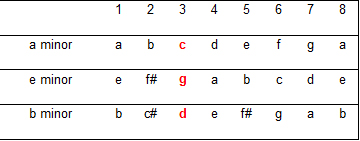
The next table shows the three natural minor scales related to the major scales above. This time, you’ll notice that the bold print red note, which is the root note of the relative major key, has changed to the third step.

In classical music, minor scales are altered in 2 different ways. This gives minor keys a more distinct and defined sound, and distinguishes them from major keys. The first alteration is the harmonic minor scale, in which the 7th step is always raised up by a half tone as shown in a harmonic minor below:

A – B: whole tone

B – C: half tone

C – D: whole tone

D – E: whole tone

E – F: half tone

F – G#: augmented second

G# – A: half tone

The augmented second is the largest interval you’ll find in any classical scale, and is only found in the harmonic minor. Play and listen to the scale several times to hear its distinct sound.  The table below shows 3 examples of harmonic minor scales. The altered 7th steps are in bold italic.

Now for the melodic minor scale, which I like to call the chameleon scale because it changes its colours on the way down.  Melodic minor scales raise the 6th and 7th steps by a half tone in the ascending half and lower them back down by a half step in the descending half. This means that the scale has a different sequence of intervals in its ascending and descending halves as shown in a melodic minor:

Ascending

A – B: whole tone

B – C: half tone

C – D: whole tone

D – E: whole tone

E – F#: whole tone

F# – G#: whole tone

G# – A: half tone

Descending

A – G: whole tone

G – F: whole tone

F – E: half tone

E – D: whole tone

D – C: whole tone

C – B: half tone

B – A: whole tone

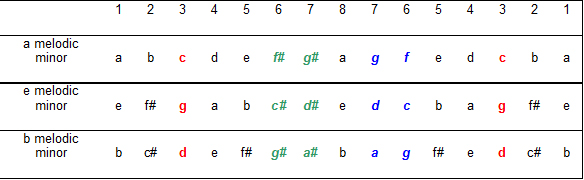
Note also that the descending melodic minor scale is a natural minor which follows the key signature.  Play and listen to the scale, and be sure to hear the difference between the melodic minor and the harmonic minor. The table below shows 3 examples of melodic minor scales. The relative majors are once again marked in bold red; the altered notes in the ascending scale are shown in bold italic green, and the lowered notes in the descending scale are shown in bold italic blue:

The altered notes in harmonic and melodic minor scales are always shown as accidentals within the score, and not in the key signature.

So how do we know whether a piece of music is in a minor key or a major key? First look at the key signature and make sure that you know which major and minor key it belongs to. Then look at about the first 8 bars of the music. If you see any accidentals within the score (not, the key signature – you’ve already looked at that) check what they are. If they happen to be the 6th and/ or 7th step of the minor key, then you can be certain that the music is in a minor key and not a major key.  If you see no accidentals within the score, or accidentals that are not the 6th or 7th steps of the minor key, you can be certain of it being a major key.

© D C Cello Studio

Order or download my latest electronica-cello feast, Cellotronics

© D C Cello Studio

Essay on the Craft of ‘Cello-Playing by Christopher Bunting: A Short Review

An essential read for any serious cellist or cello teacher. Christopher Bunting (1924 – 2005) was a world-renowned cellist and pedagogue whose methods and compositions have become an integral part of the cello-verse. He singled himself out as a teacher with his deeply intellectual and holistic approach to the learning process, stressing the importance of the psychological influence over the physical act of playing in each individual.

Essay on the Craft of ‘Cello-Playing goes into great detail on the psychology of playing, offering a great deal of food for thought and encouraging each cellist to closely examine his or her emotional and intellectual workings in order to assess why they encounter certain (well-known) physical hurdles on the instrument, and work out how to overcome them. Bunting clearly didn’t believe in short-cuts, and his playing was certainly a testament to this fact. Described by the Daily Telegraph as “a Master” and Die Welt as having “highly developed musical comprehension, prodigious technique and outstanding artistry”, we are left in no doubt as to what incredibly good hands we’re in from the first word to the last.

Christopher Bunting was by many accounts an intense and inspiring teachr with a fertile musical imagination and a dry sense of humour, all of which is evident and comes across rather beautifully in his writing. Expect silly puns at unexpected moments along with fabulous analogies and comparisons that put difficult concepts into sharp perspective.

Essay on the Craft of ‘Cello-Playing is more than a treatise on playing the cello, and also contains imaginative and hugely helpful exercises (many of which feature in the much more condensed Portfolio of Cello Exercises) with detailed explanations on what each is for, and how best to approach it.

Not an easy read, being fairly dense and packed with a remarkable amount of information and thought, but I can’t recommend it enough. Persevere if you find it heavy-going at first!

© D C Cello Studio

Can Cello Really be Self-Taught?

Speaking as a classically trained cello teacher who herself underwent years of tuition at school and Music College, I won’t deny that I am extremely biased. I simply can’t get away from the notion that learning an instrument like the cello can only be a successful endeavour under the instruction of an experienced and capable teacher, and even under those circumstances it certainly won’t work out for everyone. Am I being close-minded? As I conduct research for my own video/ e-book companion for cello students, I keep stumbling across teach-yourself cello methods that promise to enable literally anyone to play. Since none of the methods I have encountered thus far have actually given a definition of what “playing” actually is, I suppose they are not necessarily offering false hope – providing those subscribing to the methods do not equate playing with being able to perform great repertoire or play in a professional level orchestra. Many might argue that drawing the bow across the string to make a passable sound is also playing.

Furthermore, I don’t deny that certain instruments have a long list of outstanding self-taught players. It is more than possible to teach oneself to play an instrument and even take that skill to a professional level. However, I don’t believe that certain instruments – particularly the violin, the viola or the cello – lend themselves at all well to self instruction. I should add at this point, that I will not be drawn into the utterly pointless arguement of which instruments are “easier” or “more difficult” to play, and I am not suggesting that stringed instruments fall into either category. What I am considering, is the accessibility of these instruments when the student has no idea how to hold them, how to hold the bow, or where to place their fingers. I’m sure we can all agree that one of the most disagreeable sounds in the world is that of a violin or cello in the hands of a beginner. Whereas a piano or guitar – both instruments being more “user friendly” with a more intuitive interface to those who have never attempted to play them – may sound dull or uninteresting in the early stages, but never quite as dreadful as a stringed instrument.

Perhaps you think I’m being a snob, and that my concern is not based on the actual practicalities of learning the cello without a teacher, but on the implications of this actually being possible. If more and more people begin to realise that playing the cello is an achievable goal without the costly help of a tutor, people like me will be out of a job. I’ll tell you why I don’t lose sleep over the prospect of losing my business to self-instruction methods: even if it is possible to become a skillful cellist with only the assistance of a book and a few videos, there is a limit to the number of people out there who prefer the “DIY” approach.

As for whether anyone can learn to play the cello as well as they’d like to by following video and book instructions, I believe I’m looking beyond my personal bias when I say that I am far from convinced. Without regular feedback and correction on fundamental issues such as posture, balance, intonation and bow technique (and that’s just for starters) it simply isn’t possible to develop technique that isn’t fraught with tension and bad habits. One of the greatest sources of frustration for musicians is physical tension, pain and injury caused by inadequate technique. So even if your motivation for learning the cello is “just for enjoyment”, there is very little enjoyment to be found in trying to do something that just makes us feel out of our depth. Am I saying that those who study cello with a teacher will not encounter these problems? Sadly not. You may find yourself with a perfectly good teacher but simply not “gel” with him. You might end up with a less than capable teacher whose motivation is to earn a few extra bucks as opposed to helping you to find and develop your musicality. Or you might have an inadequate practice routine. There are many factors that can hinder the development of a music student of any instrument. My feeling is that without a good teacher, all of these factors will be stacked much more heavily against you. A good teacher gets to know her students on a number of different levels – personality, intellect, physical aptitudes, musicality – in order to develop an individual approach to each student. She will never take a one size fits all approach when helping a student to solve problems. A book or video series, no matter how well written and demonstrated, can only offer one approach which won’t work for everyone. It cannot offer several alternative means of explaining each concept without becoming saturated, unreadable and far too lengthy.

I would welcome comments from anyone who is currently teaching themselves to play the cello or has ever attempted to do so. What method did you chose and why? How would you describe your progress? What are your goals for your cello playing?

© D C Cello Studio