Introduction to Pairing Positions on the Cello

Cello students who have studied the entire range of the cello will almost certainly have discovered a recurring pattern of similarity between certain positions one octave and string apart. Recognising this pattern can be very useful when it comes to getting secure in the higher positions, the fear of which often causes poor intonation and inferior tone production. The pairing I’ll be discussing in this and the following four posts is as follows:

1. First and fourth positions:

1.1   First position on the D string and fourth position on the A string
1.2   First position on the G string and fourth position on the D string
1.3   First position on the C string and fourth position on the G string

Also:

1.4   Half position on the D string and upper third/ lower fourth position on the A string
1.5   Half position on the G string and upper third/ lower fourth position on the D string
1.6   Half position on the G string and upper third/ lower fourth position on the D string

2. Second and fifth positions:

2.1   Second position on the D string and fifth position on the A string
2.2   Second position on the G string and fifth position on the D string
2.3   Second position on the C string and fifth position on the G string

3. Third and sixth positions:

3.1   Third position on the D string and sixth position on the A string
3.2   Third position on the G string and sixth position on the D string
3.3   Third position on the C string and sixth position on the G string

4. Fourth and seventh positions:

4.1   Fourth position on the D string and seventh position on the A string
4.2   Fourth position on the G string and seventh position on the D string
4.3   Fourth position on the C string and seventh position on the G string

The first pairing (first and fourth positions) shares identical fingering patterns since both are neck positions. The same applies to lower second and lower fifth positions. From extended fifth position onwards, the three finger system comes into use, so the notes of the paired positions remain the same but the fingering does not. The changes are as follows:

In the higher positions, the second finger plays notes that would be covered by the second and third fingers in the lower positions.
In the higher positions, the third finger plays notes that would be covered by the fourth finger in the lower positions.
This discrepancy applies to closed and stretch (or extended) positions.

The following four posts will show these pairings through simple exercises and melody lines.

Teaching Music: Calling versus Business

Today did not start well. I hadn’t even taken my first sip of tea before I noticed an unread text message on my phone from one of my new students. I knew what it was going to be about. Nonetheless, I opened it and was faced with a lengthy excuse for why she would not be able to make her lesson scheduled for 10 am. I felt the temperature of my blood threatening to reach boiling point, and decided not to reply until I had finished my first cup of tea. This was in the hope that I would feel less inclined to send a message that would make a sailor blush. There are further reasons for why I should react quite so explosively to a cancelled lesson, but they are not important or ultimately what this post is about.

You see, this particular irritation has happened in the middle of what I can only describe as a major reassessment of my role as a teacher and the business I am running. It highlights issues that private teachers (not only in the field of music) face the world over. This is only one of the many issues we wrestle with in our day-to-day professional lives. Other transgressions sure to raise my blood pressure include late or missed payments, failure to practise, and constantly changing what should be a regular lesson time. Some of these problems create financial discomfort, while others are frustrating to my pedagogical sensibilities. In other words, some students can be bad for business while others can be bad for our professional progress. Here I should point out that such students are always in the minority. The majority of people who make the investment in private lessons for themselves or their children do so out of a genuine desire to learn, or to enrich the educational and personal development of their children.

However, it only takes a few time-wasters to cause a disproportionate amount of frustration and stress. At the earlier stage of one’s career, the notion of terminating lessons is unthinkable unless it’s the student doing the terminating, and that’s never easy to accept. This was certainly my perspective when I was building my practice and really needed more students, not fewer. But thinking back, there was never a “problem” student who didn’t end up quitting their lessons within one year of starting. I might have saved myself a good deal of that frustration and stress if I had shown them the door as soon as I realised that they weren’t going to be long-term prospects. One of the reasons I never did (apart from the obvious fear of reducing my earnings) was the voice of my idealistic inner teacher, which told me I could inspire them to become committed cello students with persistence and the exploration of every possible avenue. I am pleased to say that I haven’t lost that nagging voice. I believe it is a very important aspect of what makes me a good teacher. Everyone who embarks on the journey of learning to play an instrument experiences periods of self doubt and despondency. At times like these they need a teacher who recognises what they’re experiencing and refuses to let their self doubt win. Fifteen years after giving my very first cello lesson I have learned to determine when to embrace the idealistic inner teacher voice and when to listen to my business head, which has taken some time to find its voice.

When I began teaching professionally my philosophy was that anyone – no matter what age, background or experience – could learn to play the cello if they really wanted to. Fifteen years later my philosophy remains the same, but I have learned that a person who decides to take cello lessons isn’t always a person who really wants to play the cello. I used to think that only young children who were forced into music lessons fell into that category. I have since learned that the most enthusiastic adult beginners can lose interest very quickly, and the most unwilling young beginners can turn into passionate players. You can never really tell from first impressions.

What I have also come to realise in my gradual epiphany, is that I am running a business which makes up a significant percentage of my overall income as a musician. That may sound like a feeble epiphany, since any freelance activity in which money is charged for a professional service is a business. But we musicians are not known for having business heads. We work in a nebulous, subjective and ever-changing industry which is notoriously difficult to succeed in. Qualifications, while often required depending on which avenue we choose, do not make us musicians in the way that they make doctors, accountants or lawyers. So we enter our field with gnawing doubt and uncertainty, never convinced we’re good enough to do what we do and always convinced that we shouldn’t charge too much for fear of being arrogant or simply being laughed out of the room. It takes a while to shake those feelings and some never do. But the sooner you realise that your students (the bad apples aside) keep coming back to their lessons because they have confidence in what you do, the better. When you realise that, you’ll realise that there is nothing wrong with telling people you’re good at what you do, and nothing wrong with expecting a certain level of commitment and respect from your students. If they have no respect for your business and the value of what you are doing for them, it is unlikely that they will have any respect for your expertise. Would a lawyer or an accountant take on such a client?

You might be wondering about the content of my reply to the hungover student. I told her to get well soon, and that I looked forward to hearing back from her on Wednesday. Does that negate everything I have just written? No. There has to be a certain amount of leeway. She has two strikes, but she has also shown real enthusiasm. She has only just begun and she knows exactly what my expectations are because I have explained them and given them to her (and every other student I teach) in writing. I still see in her the potential that I see in all of my new students. Should she strike again, she’ll have to find another teacher, and perhaps she’ll treat that teacher with a little more respect when she realises that we’re not mugs who were born yesterday. And she may turn out to be a very capable amateur musician under my guidance. I hope it’s the latter, but I’ve made peace with the fact that not every student who comes through my door will turn into a joyful story to add to my memoires.

© D C Cello Studio

Worksheets for Your Beginner Students

The following worksheets are designed to help your younger beginners associate notes belonging to the key of C major on the stave with notes on the fingerboard in first position. They combine music theory (learning to write neatly and accurately on the stave) with basic cello theory (learning the notes and fingering of first position). Each document is arranged in the order of an ascending C Major scale (2 octaves) – one page per note. By mixing up the pages you can make the worksheet more challenging. Kept in their current order they will be much easier to do, but a good way to introduce the C major scale.

These worksheets are free to download and print out, but please observe the copyright: no selling, no incorporating into other works or documents. Feedback welcome – especially from those who try them out!

© D C Cello Studio

Introduction to the Three Finger Positions on the Cello

Once you have thoroughly learnt the neck positions (from half position to fourth position), it’s time to break into the higher register of the cello. Beyond fourth position, we encounter a new fingering system to accommodate the diminishing physical space between the fingers and the changing angle of the left arm. Hence, positions five to seven are called the three finger positions. Mastering this portion of the fingerboard is an exciting time. The extended range unlocks the door to a vast amount of repertoire, much of which is not transcribed or arranged, but unaltered and intended for the cello. It also presents a steep learning curve. If you haven’t encountered it already, you’ll have to begin reading in the tenor clef. Although the difference between bass and tenor clef is easy to grasp, it can take time adjusting to the new layout and getting used to switching between clefs within one piece. And of course, there is a new and rather different fingering system to learn.

Click to view enlarged image (new window)
fig.1 Equivalent notes in bass clef and tenor clef

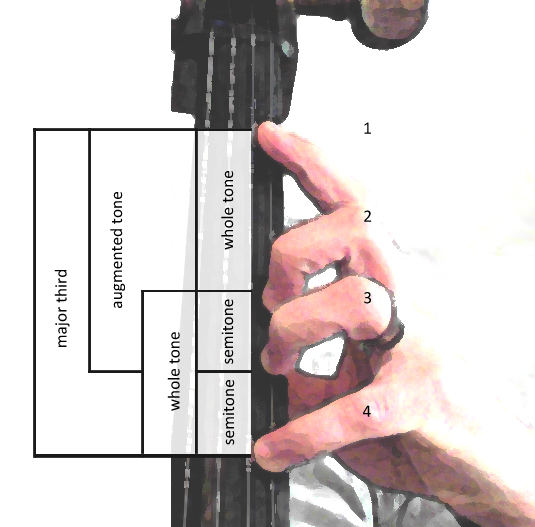
Let’s begin with a bit of revision in order to highlight the essential differences between the neck positions and the three finger positions. In the neck positions, we cover an interval of a minor or major third from the first to fourth fingers – a minor third in closed positions and a major third in stretch or extended positions. In closed positions we play semitones between adjacent fingers and whole tones between the first and third fingers or second and fourth fingers. In stretch positions we play semitones between the second and third or third and fourth fingers; whole tones between the first and second or second and fourth fingers; and an augmented second (equivalent in sound to a minor third) between the first and third fingers. This is shown in fig. 2 and 3 below:

Click to view enlarged image (new window)
fig. 2 Closed Position

Click to view enlarged image (new window)
fig. 3 Extended Position

When we consider the position of the left arm beyond fourth position, it is easy to understand why we stop using using the fourth finger. With the arm extended forward, even when the fingers remain at roughly a ninety degree angle to the strings, it is difficult to use the fourth finger without introducing a significant level of strain to the forearm. For this reason, and the fact that the intervals are physically closer together, we adopt the three finger system form fifth position onwards.

Now whole tones can be played between the first and second fingers or the second and third fingers, which maintains the maximum interval of a major third within one position. Just like first to fourth positions, each position from fifth to seventh has variants (upper and lower versions) and extensions.

Click to view enlarged image (new window)
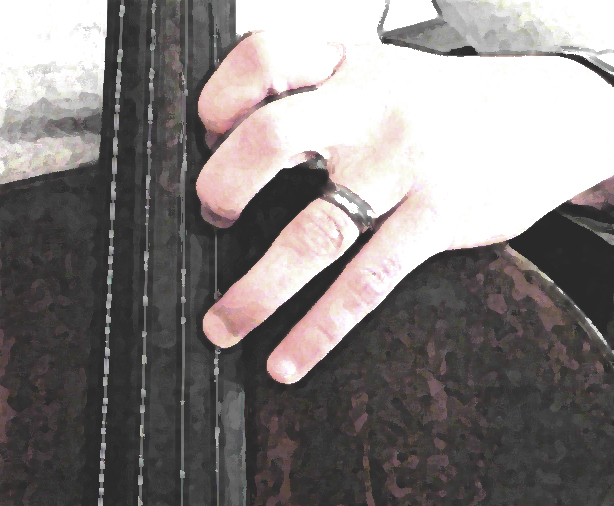
fig. 4 Closed Fifth Position (a)

Click to view enlarged image (new window)
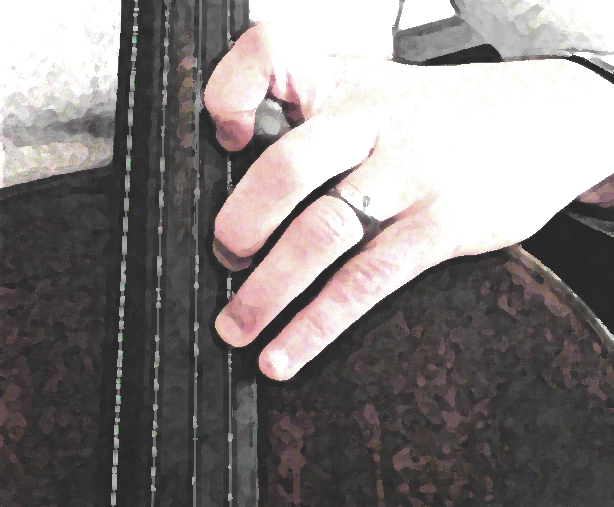
fig. 5 Closed Fifth Position (b)

Click to view enlarged image (new window)
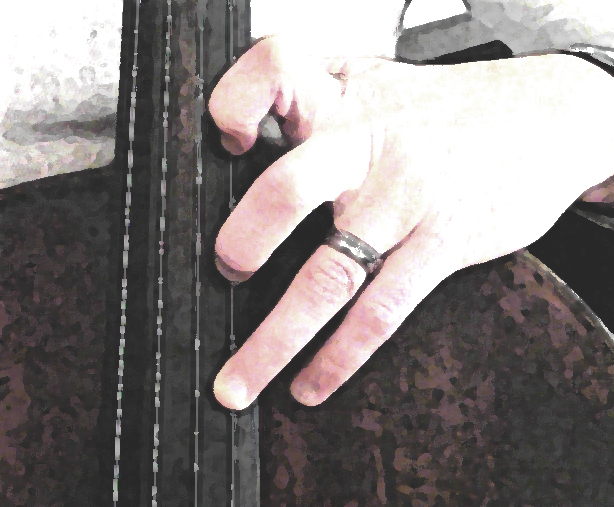
fig. 6 Extended Fifth Position

The three images above show the three versions of upper fifth position on the A string. Fig. 4 shows the closed position with a semitone between the first and second fingers (F# – G); and a whole tone between the second and third fingers (G – A). Fig. 5 shows the alternate version of the closed position with a whole tone between the first and second fingers (F# – G#); and a semitone between the second and third fingers (G# – A). Fig 6 shows the extended position where there is a whole tone between the first and second fingers (F# – G#); and the second and third fingers (G# – A#).

Chromatic variations within the position must be addressed by moving one finger while keeping the rest of the position stationary. Take a look at the following sequence, which occurs within one position (upper fifth) in the range of a minor third:

Click to view enlarged image (new window)
fig. 7 Chromatic variation within one position

The second finger is a semitone above the first finger in bars 1 and 2; and a whole tone above in bars 3 and 4. The first and third fingers remain in place so that the position itself remains stationary. The following exercise will help to develop stability in a stationary three finger position with chromatic variation, and should be repeated in all variants of fifth, sixth and seventh positions as you become familiar with them.

Click to view enlarged image (new window)
fig. 8 Position Stability Exercise

Typically, the first three finger position we encounter on the cello is upper fifth. The easiest way to find this position is to play the natural harmonic (an octave above the open string) with the third finger, then find the correct places for the second and first fingers. The following exercise will help you to find and settle into this part of the fingerboard.

Click to view enlarged image (new window)
fig 9. Fifth Position Orientation (a)

The next step is to find upper fifth position from fourth position – an area of the fingerboard that you are familiar with and overlaps fifth position. These exercises will help you to become familiar with the shift from fourth to upper fifth position.

Click to view enlarged image (new window)
fig. 10 Shifting from Fourth to Upper Fifth Position

All of the above exercises should be practised on all four strings.

Did you find this post useful? Please consider making a donation.

© D C Cello Studio 2012